In the first live-streamed genocide, Chicago challenges media narratives on Gaza
Local artists, educators, and journalists are using exhibitions, research, and storytelling to counter what they see as dehumanizing coverage of Palestinians.
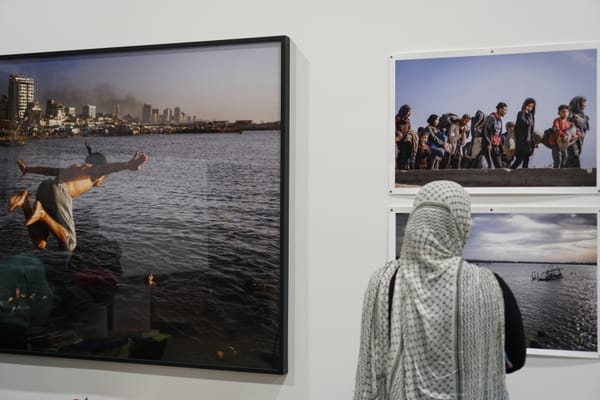
A visitor observes photographic works depicting scenes from daily life, waterfront moments, and groups of people, contemplating the human stories captured within the frames. | Provided by Bobby Vanecko
A woman stood at a Chicago gallery last August, staring at a photograph of a Palestinian child smiling. It was the first photograph she had ever seen of any Palestinian smiling, she told organizers.
Four months into a ceasefire that is violated almost daily by Israel's missile strikes on Gaza, mainstream news organizations are accused of setting the stage for genocide. In Chicago, artists, educators, and journalists are confronting media bias through education and art.
Photojournalist Ismail Abu Hatab was planning an exhibition of photos he took in the summer of 2024 in Deir al-Balah refugee camp, located in the south of Gaza, when he was killed by an Israeli missile strike in June 2025.
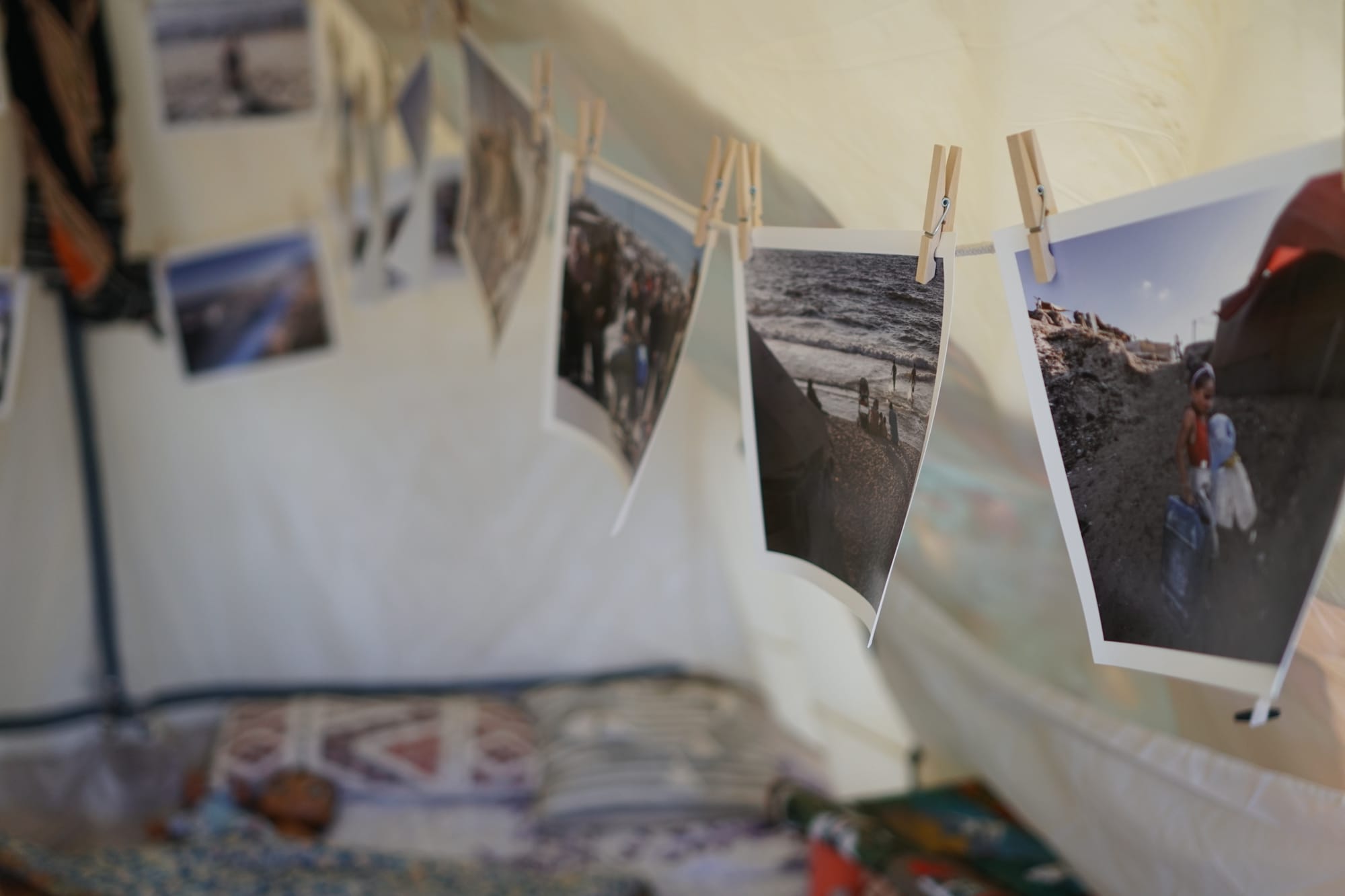
The exhibition, Between Sky and Sea, went on at Walls Turned Sideways in East Garfield Park in July and August 2025, featuring sounds and photos from Deir al-Balah and a tent to recreate conditions inside the camps.
“Ismail believed that transmitting feeling is more powerful than transmitting news,” said Ghada Hamwi, an organizer with ByPalestine, or ByPa, the organization created by Hatab to promote Palestinian art and stories.
Matt Perry is an author and organizer with ByPa, who was a friend of Hatab and was heavily involved in organizing the Chicago exhibition.
“The name Between Sky and Sea means those are the literal boundaries of their life. There's no place to go. There's the sea on one side, there's no Gaza left on the other. So it's just sky and sea.” Perry said. That observation reflects a broader pattern in American media coverage.
Reports from Prism and The Intercept showed a pro-Israel bias that has been pointed out by critics long before October 7, 2023. The Intercept's analysis found that coverage of Palestinians in major US outlets focused disproportionately on death, suffering, or Hamas, with far less humanizing coverage compared to Israelis.
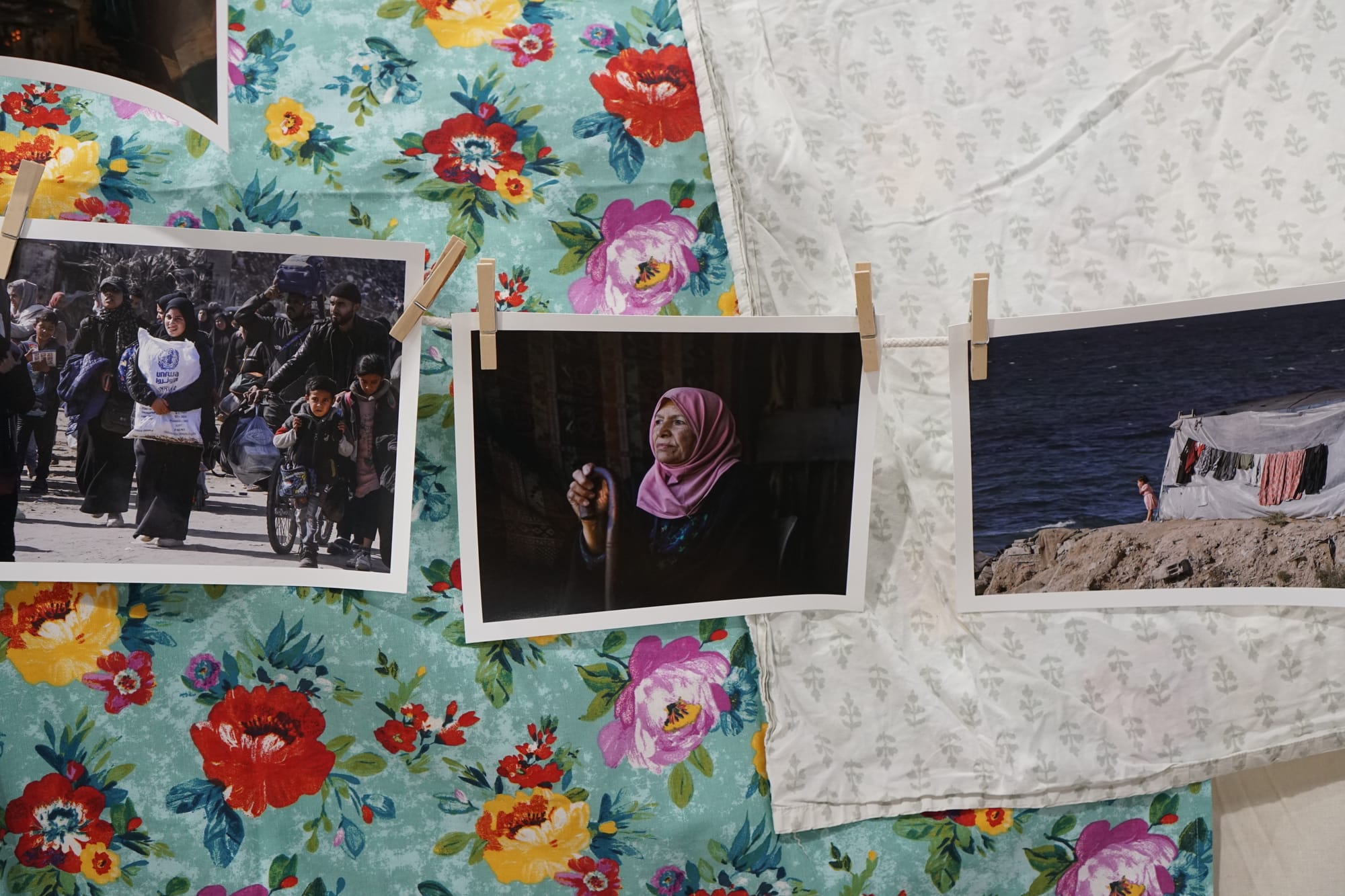
“Within that, there's a lot of photos of familial exchanges, people playing volleyball, children laughing, reading, elders passing on information, in addition to hurt, grieving, and suffering.” Perry continued.
Photographs amid colorful floral fabrics, depicting community, resilience, and daily life in Gaza. | Provided by Bobby Vanecko
The everyday moments that are relatable to many such as eating breakfast, watching the news, going to work or school are not seen.
Hamwi said, “It reveals the daily suffering caused by siege and war, while simultaneously emphasizing that the Gazan people do not surrender. Instead, they continue to resist through life itself, creating meaning, dignity, and hope out of nothing.”
Palestinians are rarely given space to tell their own stories within mainstream news. When they are, they often face questioning that forces them to prove their innocence rather than share their viewpoints.
More people are turning to alternative news outlets and stories from the occupied Palestinian territories and global solidarity movement. “I grew up with immigrant parents and my dad would always question American foreign policy. Most Americans don't really look at people who are Muslims and/or Arabs with their full humanity.” Rummana Hussain, a journalist-turned-columnist and South Asian Muslim who writes for the Chicago Sun-Times, has long been aware of the biases that exist in the newsroom.
“I actually wrote my final paper for grad school at Northwestern on the languages used to describe Palestinians and the languages used to describe Israelis,” Hussain said. “The language that was used to describe Palestinians and Israelis were completely different. There's definitely dehumanizing language when it comes to Palestinians.”
Dr. Eman Abdelhadi is a Palestinian-Egyptian American sociology professor at University of Chicago who researches Muslim-American experiences with a focus on gender. She has written about the Palestinian solidarity movement and Muslim-American experiences through 9/11 and resurgences in Islamophobia after 10/7.
“CNN, MSNBC, Fox News, these institutions have a lot of blood on their hands and have been deeply culpable in manufacturing consent for these war machines and projects that have killed millions of innocents,” Abdelhadi said. “The so-called ‘War on Terror’ killed 27 million people. It destroyed Afghanistan, so much of the Middle East, and took so many lives across the world. It's absurd to expect us to trust these sources.”
A Gallup poll from July 2025 shows that only 32% of Americans approve of Israel’s military actions in Gaza, a number that’s been steadily falling. Another Gallup poll from October 2024, shows that Americans’ trust in the media is at a record low. Perception of bias in media is one of the factors that leads to so much distrust in the media.
“I think that for many people watching these sources justify what was so clearly a genocide alongside footage of children being pulled out of the rubble, it dealt a final kind of death blow to the legitimacy of these mainstream institutions and the very power structures that financed this with our money, our tax dollars, against popular protest, against the will of the American people,” Abdelhadi said.
Photographs hang on a clothesline and capture moments of everyday life in Gaza. | Provided by Bobby Vanecko
Art is another avenue to confront dehumanizing depictions. Qais Assali, a Palestine-born University of Chicago graduate, artist, and fine arts professor, is making art out of dehumanizing language. Branding Conflict is an art project that “upends ideas of place, invisibility, erasure, nationalism, propaganda, war games, gender discourse, and resistance.”
News audiences have been presented with a narrative that many consider dehumanizing to Palestinians for a long time. In the age of social media, there are many narratives and perspectives available to audiences than ever before. Palestinians in Gaza are documenting their own lives through photos and videos, sharing moments of resilience, family life, and community that rarely make it into mainstream news coverage.
The images that come out of Gaza speak for themselves, even as more journalists are slain while trying to share information with the public. There have been 265 journalists killed since October 7th, according to Palestine Chronicle. Their work offers the humanizing portraits of Palestinian life that exhibitions like Between Sky and Sea aim to preserve. Younger demographics have an even lower approval rating of Israel’s actions in Gaza, with only a nine percent approval rating from American adults between the ages of 18 and 34.
Trust in national news organizations has been steadily declining across all age demographics, and young adults have the least, according to the Pew Research Center. Hussain reflected that many journalists are feeling exhausted from current events in the U.S., along with major events and the surrounding discourse of the past few years.
She continued, “As long as we're pushing the needle, even just a little forward, it's better than it going backwards. I do see a lot of hope in the younger generation. I get very invigorated looking at how they talk about things that I wouldn't even think about. I can be old-fashioned in some ways that I look at the newsroom, but I do like the energy from the younger generation and the questions they bring up. A lot of the ideas they have give me hope.”
CICA’s main company dance ensemble rehearses their final number at the Collaborative Institute of Cultural Arts in Brighton Park on Oct. 21, 2025. | Araceli Ramirez/15 West