Communities across Chicago and its suburbs are joining cities nationwide in rewriting the narrative around food access and green space. Residents are turning abandoned lots into vibrant spaces for growing food, building community, and practicing resistance.
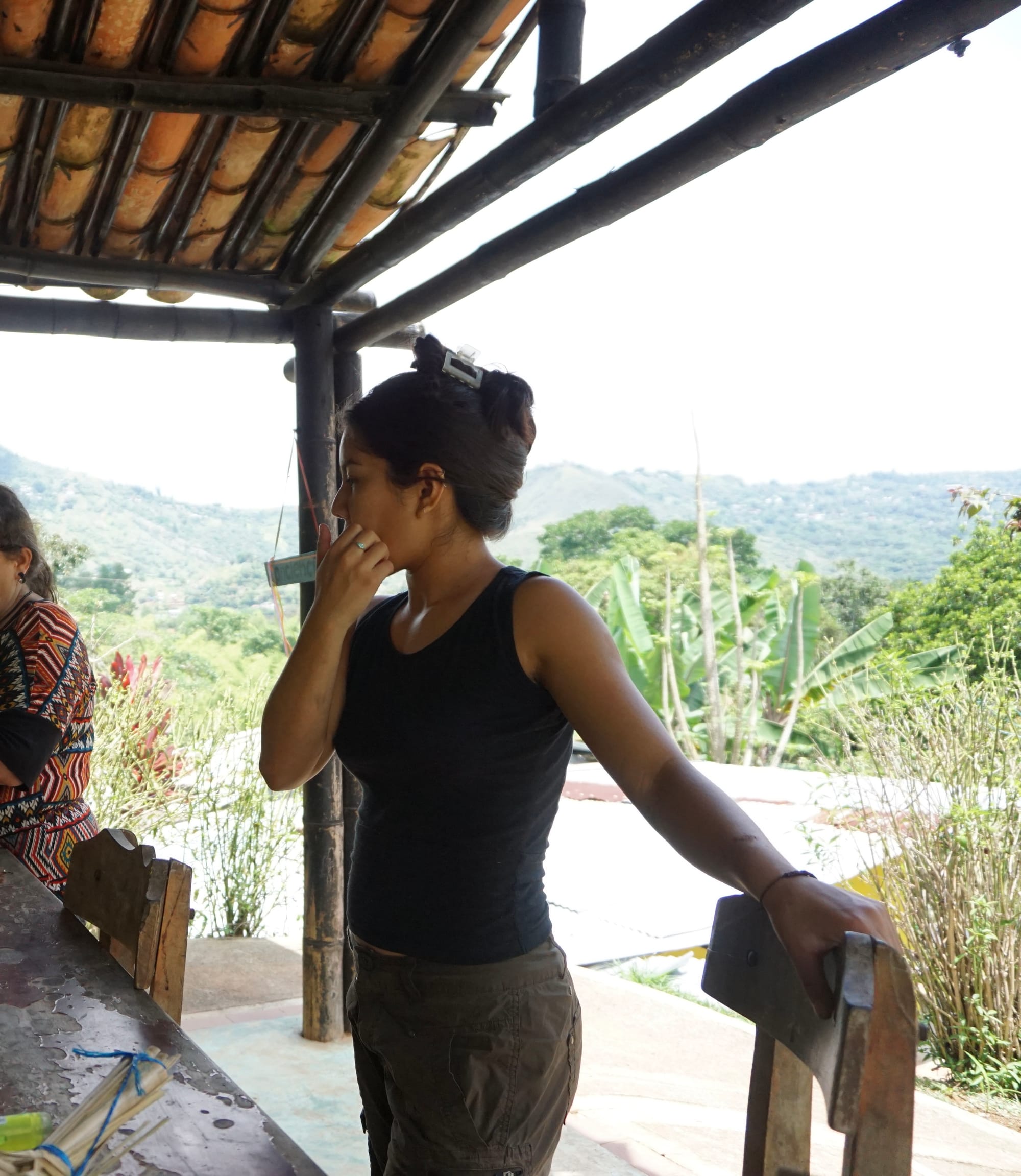
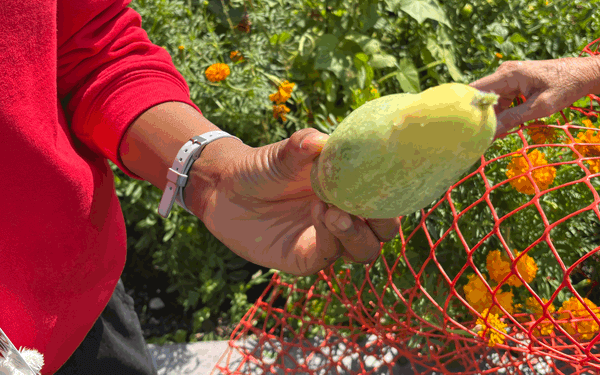
Paula Acevedo leads the El Paseo Community Garden, a green sanctuary in Chicago's Pilsen neighborhood that didn't always look this way. In 2009, this was a “brownfield” site, land abandoned and polluted from past industrial use. Today, it offers private and collective beds, a permaculture food forest, a U-pick sliding-scale farm stand, and a monarch butterfly sanctuary.
But transforming this space “was not without challenges,” recalls Acevedo, co-director at El Paseo. In 2016, those challenges deepened when the City of Chicago introduced its Paseo Rails-to-Trails proposal, promoting a new “urban greenway”. While framed as an investment in community space, the project also signaled an expected rise in property values, and, as in many gentrifying neighborhoods, higher rents often follow. For El Paseo, the threat felt immediate: a development meant to promote access to green space could end up displacing the very residents the garden exists to serve.
El Paseo is part of a growing movement across the region, where communities are transforming vacant spaces into urban gardens as a practice of cultivating their own food systems, reconnecting with the land, and taking action to nourish their neighborhoods.
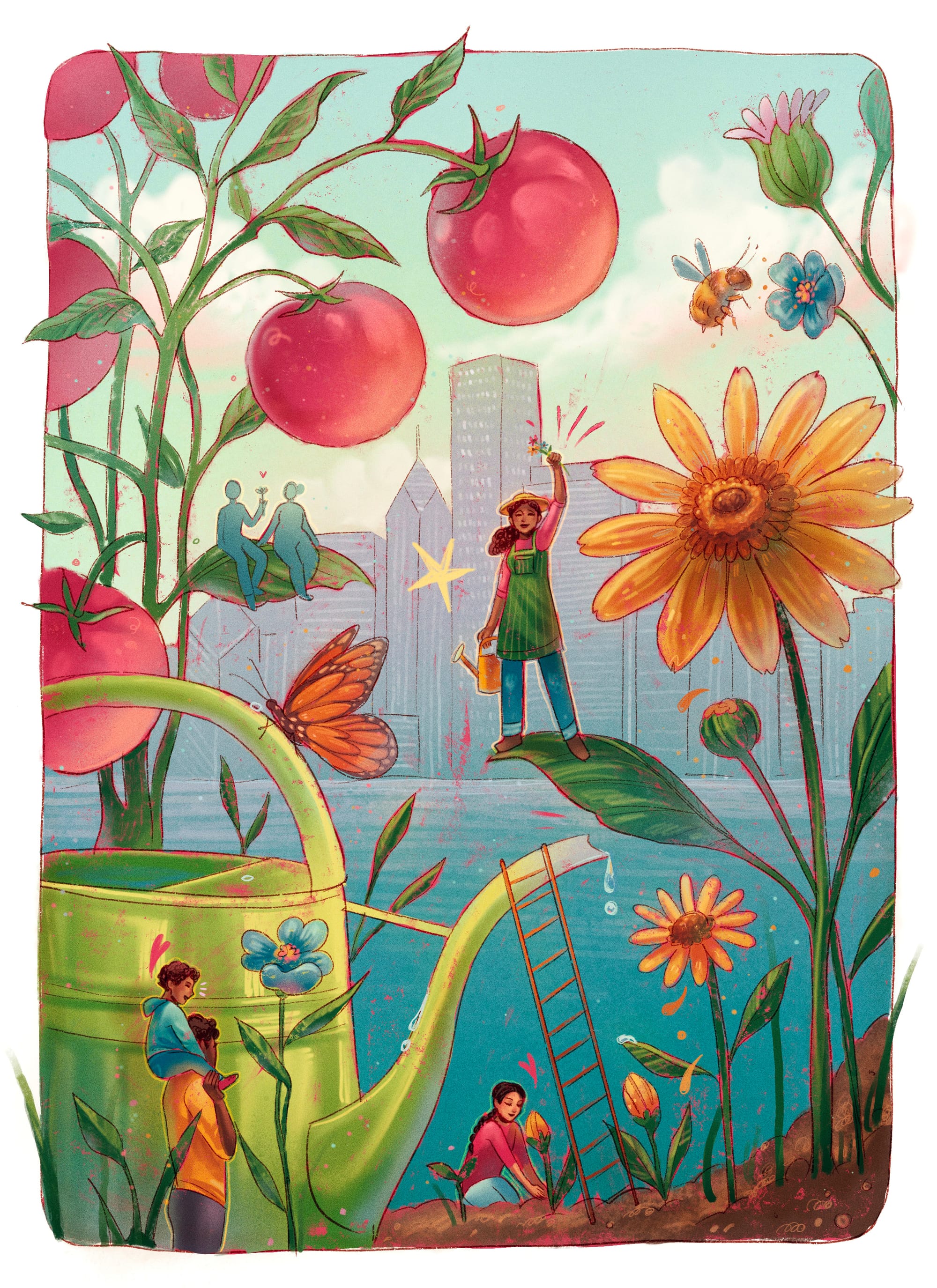
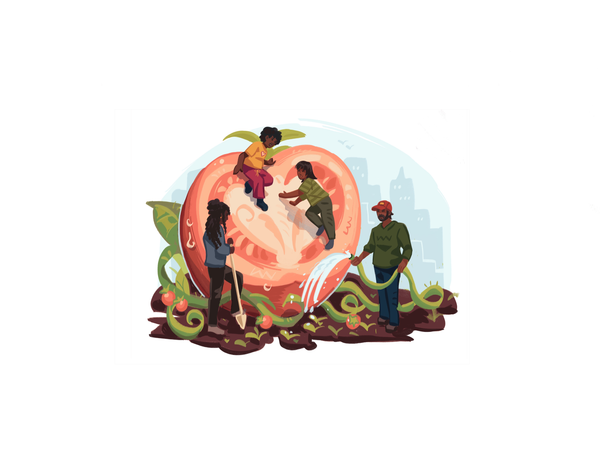
Illustration: Isabel Atienza/15West
Urban gardens typically form when a community living inside the city, without access to large plots of land, identifies a gap. The gaps range from a lack of access to fresh food, green spaces, culturally centered spaces, and/or collective healing. The community then organizes to transform an unused or neglected piece of land into a shared space that benefits the community in all these ways.
The deeply political history
Long before the term “urban garden” existed, these spaces appeared throughout history as sites of survival, resistance, and community self-determination, one of the earliest recorded examples emerging in 1890s Detroit. During the suburban sprawl of the 1970s, wealthier white families moved to the suburbs while Black, Latine/x, and immigrant communities were left in increasingly disinvested city centers. In response to these growing challenges, urban residents began transforming abandoned lots into gardens to confront food insecurity, environmental injustice, and government neglect.
55 years later, these same communities are once again facing neglect from city governments, political criminalization, the end of funding for social justice initiatives, and a lack of food access in the most economically vulnerable parts of the city. Facing these pressures, West Side Chicago community members are creating networks of food sovereignty, growing their own food and relying less on costly external food systems, while expanding access to green community spaces.
This movement is already visible across the West Side, where some of the most recognized urban gardens include the Maxwell Street Community Garden (MSCG) and the Urban Growers Collective (UGC). MSCG currently offers 60 garden beds and has grown into a vibrant neighborhood space with regular programming, including workshops and classes on beekeeping, yoga, butterfly gardens, and farm-to-table education.
UGC now operates eight urban farms across Chicago, totaling 11 acres of cultivated land and producing roughly 23,000 pounds of food each year, with a focus on distributing fresh produce to BIPOC communities. Through initiatives like the Grower & Herbalism Apprenticeship Programs, which offer hands-on training in farming, herbalism, and cooperative work, UGC is also cultivating the next generation of growers and strengthening the youth's connection with land in their own cities.
Alongside these larger organizations, smaller neighborhood gardens like El Paseo are reminding and inspiring us of the possibility of cultivating and sustaining growing spaces in our own corners of the city. In Berwyn, students are doing similar work, transforming their school's forgotten garden into a thriving community space.For El Paseo, that meant confronting the threat of displacement head-on.
The movement taking root
In response, Pilsen residents organized around a shared goal: to rewrite the narrative and “change the pattern” of who gets to access and steward land in this country. Acevedo explains that, “given the cultural and historical disconnect that our communities suffer from land,” many do not initially imagine themselves belonging in these green spaces. By centering elders and BIPOC community members, she hopes to dismantle the false idea that green spaces are amenities reserved for the wealthy, and to affirm that these spaces have always belonged to communities of color, too.
The garden continues to thrive; however, its greatest harvest has always been the connections it grows.
Want to grow your own urban garden? Download our zine
Acevedo describes how tending the land teaches responsibility, reciprocity, and collective care. “When you work with the land, you get back what you put in,” she says—a reminder that mutual care is a practice. In an increasingly individualistic society, working in community restores the practice of shared responsibility, reminding us that care is a collective effort rather than an individual burden.
For many who come through the gates, gardening is also a return to memory, to culture, to lands near to the heart yet physically far. “For a lot of people, being and working with the land reminds them of home,” Acevedo says. In such a vibrant and diverse community, the soil becomes a bridge to traditional practices of nourishment and resistance.
What takes root at El Paseo goes beyond food. In a country where access to land has long been treated as a privilege, this garden insists on something more radical: that spaces for community care are both a right and a collective effort. It is also a practice of repairing and rematriating the land—planting values for future generations to remember and continue.
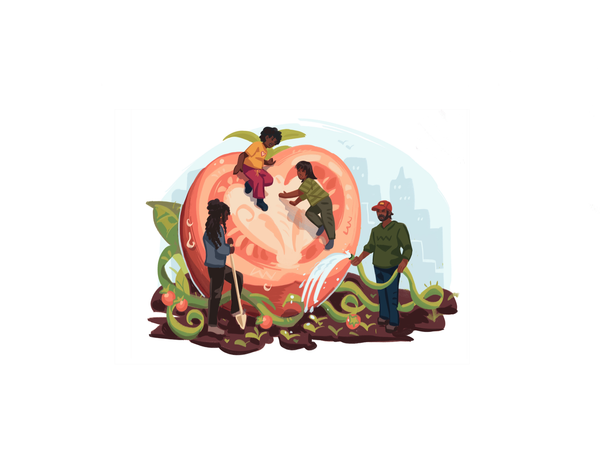
“It’s not just about tomatoes, you grow community.”
Republish This Story
This story is available for republication under a Creative Commons Attribution-NoDerivatives 4.0 International License. You may republish this article with attribution to the author and 15 West, but you cannot modify the text.
Liana Ordoñez is an aspiring bilingual journalist whose work nationally and internationally has an emphasis on social justice. She continues to grow her experience highlighting the stories and voices of the marginalized.
Comments
P.E.R.R.O. members rally outside City Hall. | Provided by Zitlalli Paez
A visitor observes photographic works depicting scenes from daily life, waterfront moments, and groups of people, contemplating the human stories captured within the frames. | Provided by Bobby Vanecko