Brookfield Zoo turns its East Mall into a concert venue. Here’s how it works.
Roaring Nights brings sold out concerts to Brookfield Zoo Chicago’s East Mall, where organizers must balance visitor access, live entertainment and animal welfare.
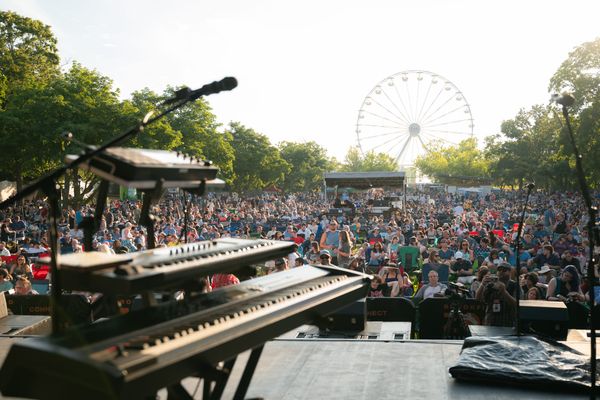
A crowd gathers on Brookfield Zoo Chicago’s East Mall during a Roaring Nights concert, with the zoo’s Ferris wheel visible. | Provided by Brookfield Zoo Chicago.
The day before a Roaring Nights concert, Brookfield Zoo Chicago’s East Mall begins changing.
Crews bring in a stage, large LED screens, and speakers. Artists and production teams arrive the following day for sound checks before concertgoers fill the lawn.
“Basically, the zoo turns into a Roaring Nights concert venue,” said Kelsey Mauro, the zoo’s associate vice president of communications.
The final two concerts of the zoo’s 2026 series are Blues Traveler on July 24 and Nelly on July 25. Both shows, which were sold out as of July 18, begin at 7:30 p.m. The East Mall opens at 5:30 p.m. for guests who purchased the $35 Early Access for Conservation add-on and at 6 p.m. for general admission ticket holders. DJ Trife is scheduled to open the Nelly concert. Concert tickets include same-day zoo admission, parking at the Main Entrance, and rides on the carousel and Ferris wheel.
But staging a major concert inside a zoo raises questions about accessibility, animal welfare, and the organization’s conservation mission.
Hosting concerts inside the zoo
Concerts are not new to Brookfield Zoo. Its first major concert was held during its 50th anniversary celebration in 1984, when the Beach Boys, Johnny Cash and June Carter Cash, and the Osmond Brothers performed on the football field at Riverside-Brookfield High School. The zoo has since hosted artists including Barenaked Ladies, Kenny Rogers, and Third Eye Blind.
The concerts use general admission lawn seating rather than assigned seats. Guests may bring chairs, blankets, outside food, and nonalcoholic beverages. Large screens allow people farther from the stage to see the performers, Mauro said.
Accessibility at outdoor events
Mauro said Roaring Nights includes two roped-off accessible seating areas. One is closer to the stage, while the other is farther away for guests who want more distance from the speakers.
The second area gives visitors another option if they do not want “extremely loud speakers in front of your face,” she said.
Brookfield Zoo also offers KultureCity sensory bags at Guest Services near its North and South gates. The bags contain noise-reducing headphones, strobe-reduction glasses, fidget tools, a feeling thermometer, and visual communication materials. The zoo’s KultureCity designation reflects its participation in the nonprofit’s staff training and sensory-support program.
Signs throughout the zoo identify areas that may have strong sounds, smells, or other sensory experiences. The zoo also identifies quieter areas where visitors can take a break.
The ADA National Network’s guide for temporary events advises organizers to consider the full visitor experience, including paths across the venue, ground conditions, restrooms, communication services, and information provided before the event.
Brookfield Zoo’s Roaring Nights page lists the concert entrances, general admission lawn seating, and available bathrooms. It does not publicly explain where the two accessible concert areas are located, how many people they accommodate, or whether companions may sit in them.
Guests who need more detailed information about accessibility at Roaring Nights can review the zoo’s accessibility guide at brookfieldzoo.org/accessibility or contact staff in advance at accessibility@brookfieldzoo.org or by phone at (708) 688-8000.
What makes a temporary event accessible?
The ADA National Network recommends that disabled visitors be able to obtain information before an event, reach and move through the site, attend performances, and use amenities such as restrooms.
For lawn events, accessible routes should be firm, stable, and slip-resistant. Grass may be usable when the soil is firm and the grass is cut short, but rain can make a lawn muddy or difficult to navigate.
Event publicity should also identify accessible parking, restrooms, and available services, along with instructions for requesting accommodations.
How loud can a zoo concert get?
Mauro said Brookfield Zoo uses a 95-decibel limit measured toward the back of the venue, a threshold she said is intended to prioritize animal welfare. That limit is specific to Brookfield Zoo, while the effects of sound can vary among animal species and environments.
Lincoln Park Zoo’s Animal Welfare Science Program notes that animals hear differently from humans and from one another. Its researchers therefore pair decibel readings with observations of animal behavior and where animals choose to spend time within their habitats.
And a preliminary study at Melbourne Zoo found behavioral changes among penguins and peccaries during concerts. Researchers recorded average sound levels of about 73 decibels at the peccary exhibit and said the exposure could present a welfare concern. They could not determine, however, whether the changes indicated stress or whether the animals were adjusting to changes in their environment.
Other zoos host live music too
A number of zoos also incorporate music into their programming, although the scale and format differ.
The Indianapolis Zoo’s Animals and All That Jazz features regional musicians and is included with zoo admission, while the Cincinnati Zoo’s Tunes & Blooms pairs local performances with its spring gardens. The Toledo Zoo & Aquarium hosts free regional performances in its historic amphitheater as well as separately ticketed concerts by national artists.
These programs range from smaller performances that extend a regular zoo visit to major touring concerts like those presented by Brookfield and Toledo.
They place Roaring Nights within a broader regional practice of using zoo grounds for cultural programming without suggesting that every zoo is becoming a concert venue.
Concerts and animal care
Brookfield Zoo also presents the concerts as a way to support its work.
“What we were really trying to do is really diversify what we’re offering and giving people something new and interesting and a new way to experience the zoo,” she said.
The Roaring Nights event page says the series supports animal care and conservation, although it does not provide a public breakdown of how ticket revenue is distributed.
“Your tickets are helping support a lot of our conservation efforts,” Mauro said. “You can have fun and contribute to conservation.”
Roaring Nights combines a day at the zoo with an evening concert. For Brookfield Zoo, the series also tests how a zoo can operate as a major entertainment venue while balancing the needs of visitors with the welfare of its animals.
Republish This Story
This story is available for republication under a Creative Commons Attribution-NoDerivatives 4.0 International License. You may republish this article with attribution to the author and 15 West, but you cannot modify the text.
NaBeela is a Greater Chicago-based photographer and journalist writing about what's possible. She's a fierce advocate of the arts and brings people together around social change and accessible education. Read more: nabeelawashington.com
Comments
A voter reviews the Cook County public question asking whether Illinois should impose a 3% surcharge on income above $1 million and divide the revenue between property-tax relief and public education. | NaBeela Washington/15 West