Pilsen Residents Halted the Fisk Demolition. Eight Months Later, Residents are Demanding Answers.
Community pressure temporarily halted plans to demolish the former coal plant over contamination concerns. Now, residents are asking what has changed—and continuing to organize for whatever comes next.
Eight months have passed since community pressure paused the demolition of Chicago’s former Fisk Generating Station. Since then, public updates have been scarce. For residents of Pilsen and surrounding areas, however, the demands and questions surrounding the site are more relevant now than ever.
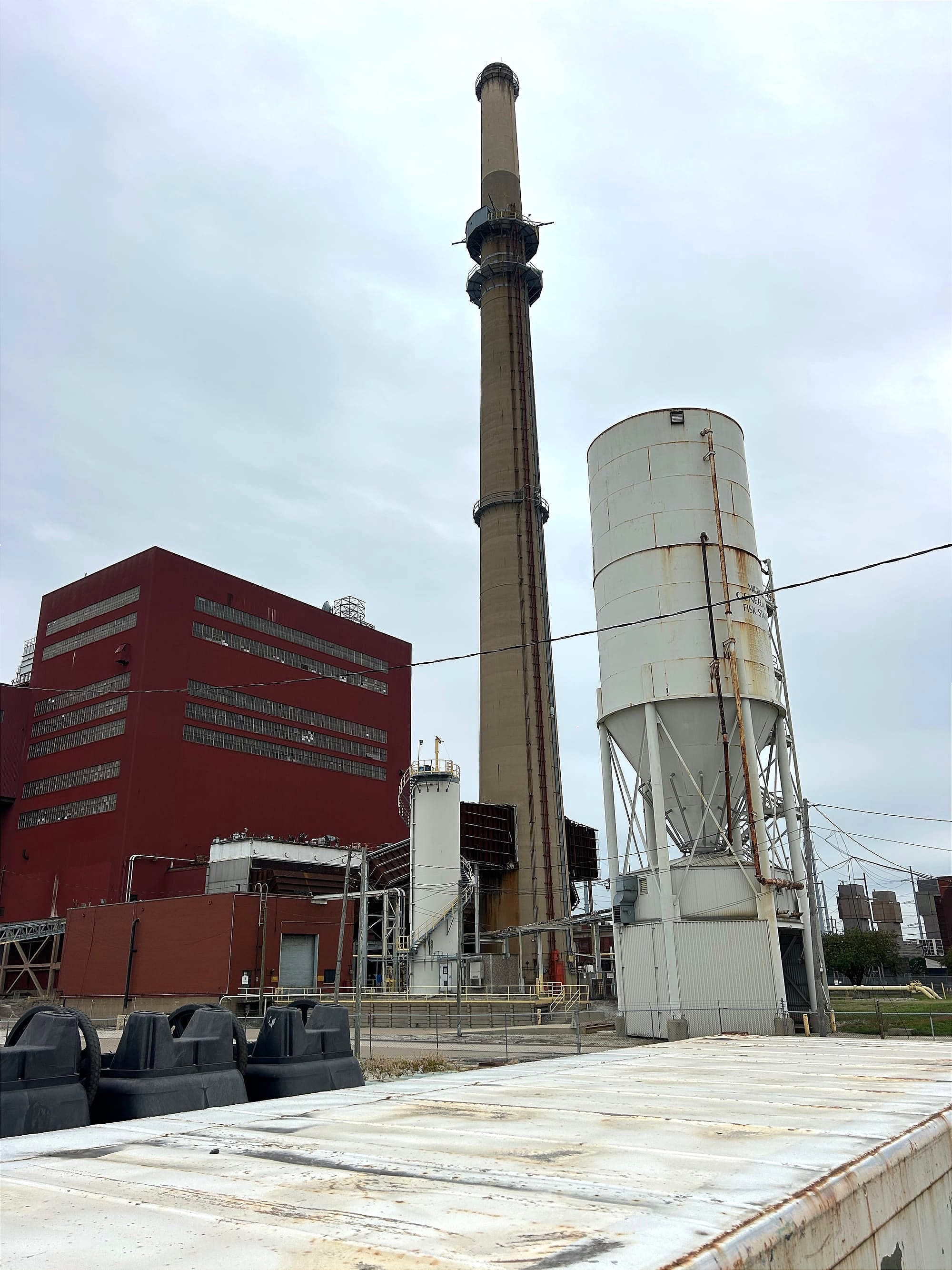
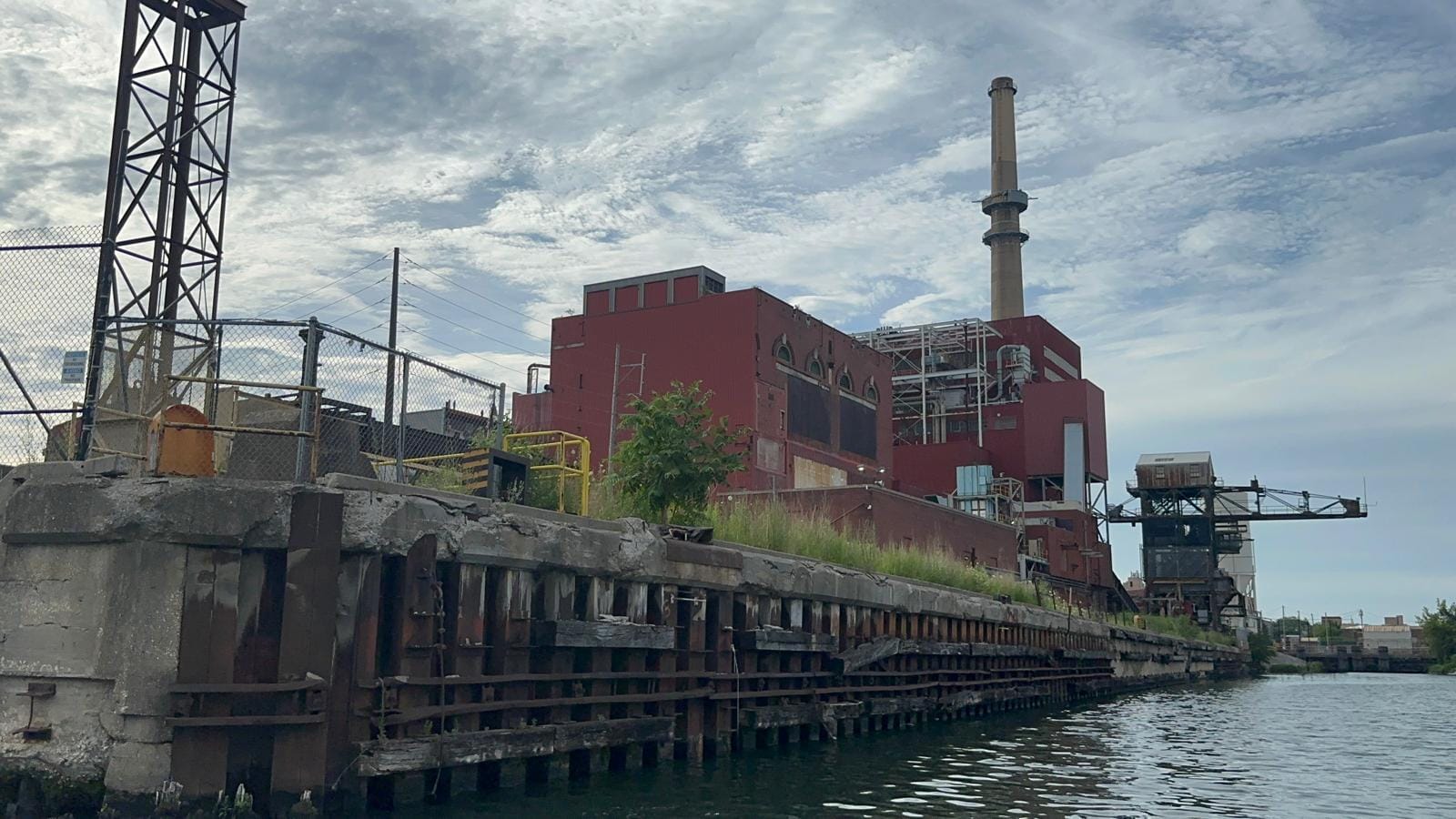
Fisk Generating Station. | Liana Ordóñez/15 West
Fisk sits in Pilsen, a historically working-class neighborhood shaped by generations of Mexican immigrants, many of whom began settling there in larger numbers during the 1960s. This place is home to families, schools, and generations of residents who are all too familiar with the consequences of industrial pollution.
The lack of public information has left organizers and residents to search for their own answers. Community members have continued conducting independent research and demanding that their concerns be formally acknowledged. They are acting with urgency, fearing that if demolition continues, they will bear the greatest risks.
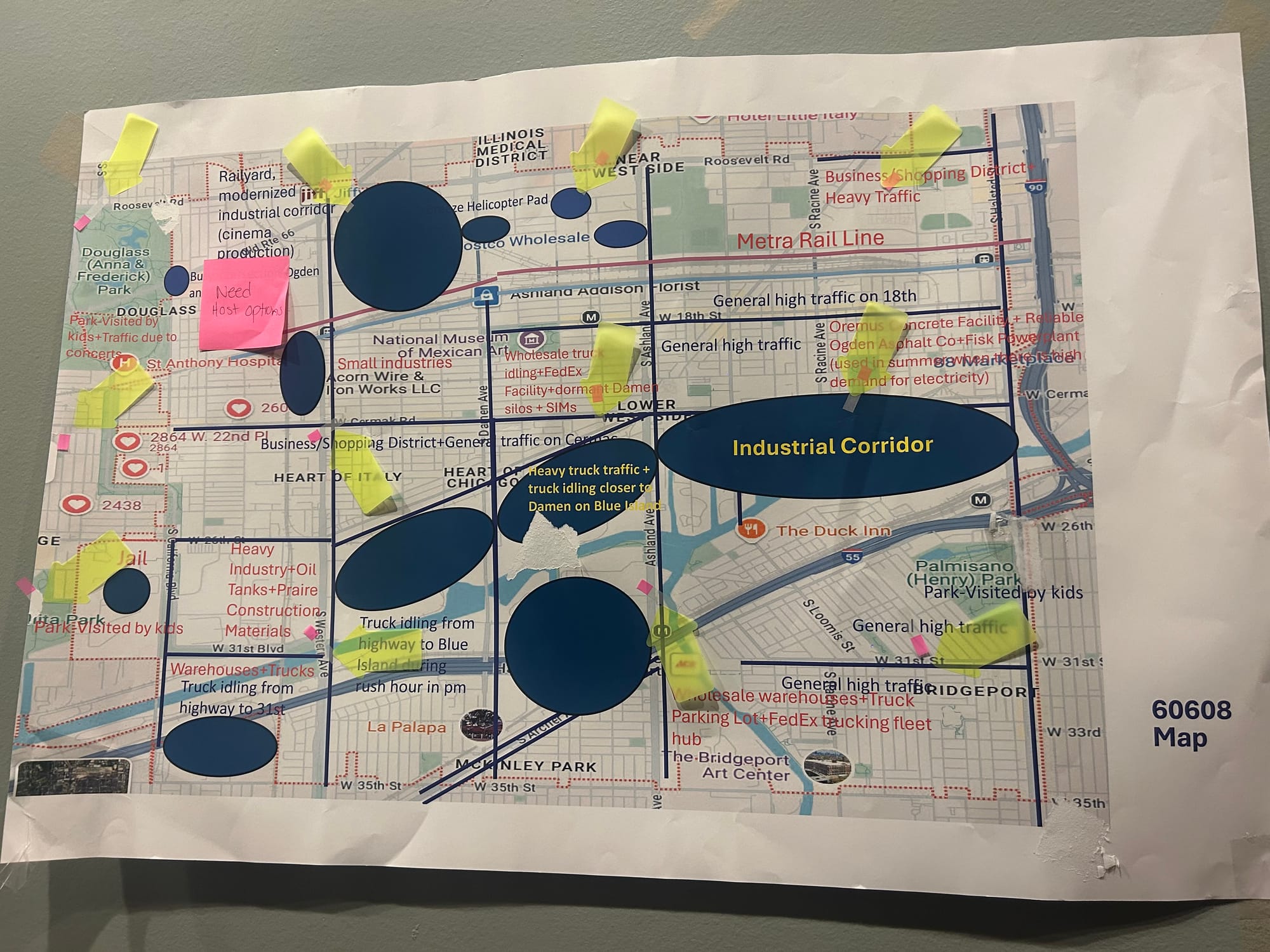
Map of Pilsen.
Their public demands are simple: proper environmental testing that is available to the community and a future use for the site that prioritizes residents over corporate interests. Through interviews with residents and organizers, 15 West examined the concerns driving those demands.
According to the City of Chicago’s Department of Buildings, Fisk’s demolition permit was issued on February 2, 2024 under application number “B101043388”. Under the Chicago Building Code, a permit is “suspended” if work has not started within 180 days after issuance, and work cannot proceed unless the “permit is reinstated.” If work is not started within 540 days, the permit expires and cannot be reinstated. If no qualifying work began before Fisk’s permit expired, a new permit would be required before demolition could proceed.
For community members, this is another opportunity for them to have their voices heard. Residents say the lack of updates from Midwest Generation, the corporation that owns the Fisk site, and Chicago government officials alike, is loud. According to organizers, efforts are underway to secure a new permit, but residents say they have received few public updates about the process.
15 West contacted Midwest Generation and the Chicago Department of Buildings for comment about the status of the demolition, permitting, and residents’ concerns but did not receive responses before publication.
“We are not saying that the demolition be stopped forever, we are just asking that if they do demolish Fisk, that proper safeguards are in place to protect the community,” says Rebeca Ramirez, longtime Pilsen resident and doctoral student in biomedical engineering at the University of Illinois Chicago whose research focuses on environmental contaminants.
Her concern is rooted in the history of this community.
In April 2020, during the early months of the COVID-19 pandemic, the demolition of the Crawford Power Generating Station in neighboring Little Village sent a massive cloud of dust across surrounding homes, coating streets, cars, and residences. For many residents, the demolition became a lasting example of what can happen when environmental risks are not adequately addressed, and communities are not kept informed.
Now, the proposed demolition of Fisk raises fears that history can repeat itself.
Fisk Generating Station from the river. | Provided by Zitlalli Paez.
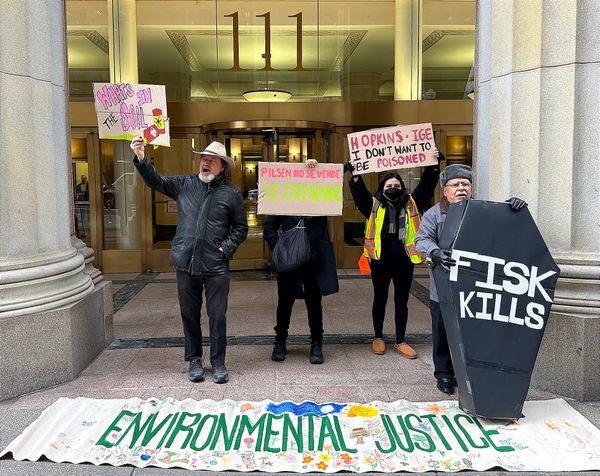
Community members say they are determined not to see that history repeated.Pilsen’s Environmental Rights and Reform Organization, known as P.E.R.R.O., has played a key role in keeping residents informed and mobilized around the future of Fisk. However, organizers stress that delaying demolition is not the same as addressing their underlying concerns.
P.E.R.R.O. president Zitlalli Paez has been in direct communication with officials in the U.S. Environmental Protection Agency, who have been “more responsive” to their concerns than local agencies. According to Paez, federal officials told organizers that resources for environmental and soil testing are available to local governments through the EPA.
Yet, Paez says local authorities have not pursued additional testing, maintaining that further assessment is unnecessary because there is no “green space” on the site that could be affected.
“From the river you can see the green space that exists,” Paez says.
Brian Holmen, a P.E.R.R.O. member and co-founder of Watershed Art & Ecology in Pilsen, says the issue extends beyond what is visible at the site. “The city failed to uphold its obligations under the law for the benefit of the community,” Holmen says. He argues that contaminants at the site could migrate into the surrounding watershed.
Holmen has created a community resource map that tracks environmental monitoring projects across Pilsen. This map also includes testing along West 26th Street, one of the neighborhood’s major industrial corridors.
For residents, the map is one way to track what is happening in their community when information from city officials remains limited.
With few public updates available, residents have turned to independent research, environmental monitoring, and community networks to track what is happening around the site and keep one another informed.
Fisk is part of a larger history of environmental harm in Pilsen. The neighborhood has lived with the aftermath of the Crawford Power Generating Station, the SIMS metal shredder that still operates down the street, and the H. Kramer smelting foundry, which reached a 2013 settlement requiring the company to spend approximately $3 million on new pollution control equipment, in addition to paying a civil penalty.
“For the people who live here, these issues are cumulative,” says Rose Gomez, a longtime community engagement organizer on Chicago’s Southeast Side.
Those concerns extend well beyond the physical boundaries of the Fisk site itself. One question residents continue to raise is where the scrap metal from the demolition will go.
According to P.E.R.R.O.’s research, metal recovered from the Fisk site is expected to be transported to SIMS Metal Management, a scrap metal recycling and processing facility located at 2500 South Paulina Street in Pilsen.
SIMS has its own regulatory history. According to records from the Illinois Environmental Protection Agency, the facility has faced regulatory action related to air pollution control violations involving volatile materials and compounds including hydrogen chloride and hydrogen fluoride. P.E.R.R.O. is currently campaigning for greater accountability from the company and protections for community health and the environment.
Photo by Oscar Sanchez.
The SIMS facility is also located near homes, businesses, and several schools serving students from pre-kindergarten through high school, including Pilsen Community Academy, Benito Juarez Community Academy, Orozco Community Academy, and Whittier Dual Language Academy, among others.
Residents’ concerns extend to future generations. Paez was born and raised in Pilsen and attended Manuel Perez Elementary. In 2010, the Illinois Environmental Protection Agency installed an air-quality monitor at the school. Several elevated readings later caused the three-month average to exceed the federal air-quality standard for lead.
For Valorie Madrid, a Pilsen resident and mother of two teenagers who attend Benito Juarez Academy, the proximity of industrial sites to schools is personal.
“Sending my kids to school in front of the plant makes me feel like a bad parent,” says Madrid. “With the proximity, it almost feels like we are using our kids as a human shield.”
For parents like Madrid, the hope is straightforward: reliable information about the environment where their children live, learn, and grow. “We know they have resources to properly test and to publicly provide us with those results, that is all we are asking,” she shares.
Their demands extend beyond what happens during demolition. “We want to be considered in the discussion of what happens to the site after the demolition,” says Rose.
The site currently occupies 60 acres of land and has the potential to become something that benefits the community rather than another space shaped by corporate interests. But the future cannot be decided without the people who live here.
The fight in Pilsen is part of a larger struggle over who gets to shape the future of communities living alongside industry. From farmworker communities on the West Coast organizing against pesticide exposure to residents in the Southwest pushing back against data centers, communities across the country are demanding more than promises. They are demanding accountability, protection, and a voice in decisions that affect their homes and livelihoods.
“When it is our home, we should have a say in what happens in it,” says Madrid.
Republish This Story
This story is available for republication under a Creative Commons Attribution-NoDerivatives 4.0 International License. You may republish this article with attribution to the author and 15 West, but you cannot modify the text.
Liana Ordoñez is an aspiring bilingual journalist whose work nationally and internationally has an emphasis on social justice. She continues to grow her experience highlighting the stories and voices of the marginalized.
Comments
Grillz-making workshop attendee inspecting her mold. | NaBeela Washington/15West
El graduado de secundaria de primera generación Forylan Suarez y su familia enfrentaron numerosas barreras sistemáticas para navegar el sistema de educación pública. | Max Herman/Borderless Magazine