Brown or Williams? What to Know About the District 5A School Board Race
Two candidates seeking to represent Chicago's West Side faced questions about school funding, closures and student success at an October 1 forum. Here's what they said, what the Board can actually change and how to vote.
When asked how Chicago Public Schools should make difficult spending decisions, LaPamela Williams proposed reviewing the district's budget line by line. Her opponent, incumbent Aaron "Jitu" Brown, rejected the idea that neighborhood schools should have to accept fewer resources.
It was one of the clearest distinctions to emerge during an October 1 candidate forum at Michele Clark Academic Prep Magnet High School in Austin.
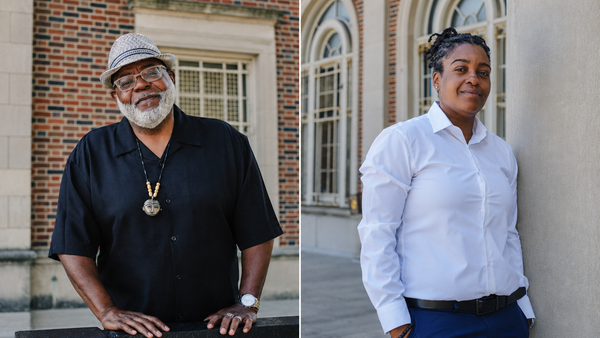
Brown and Williams are competing to represent District 5A on the Chicago Board of Education, a West Side district where longstanding school disinvestment, declining enrollment and unequal academic opportunities remain concerns.
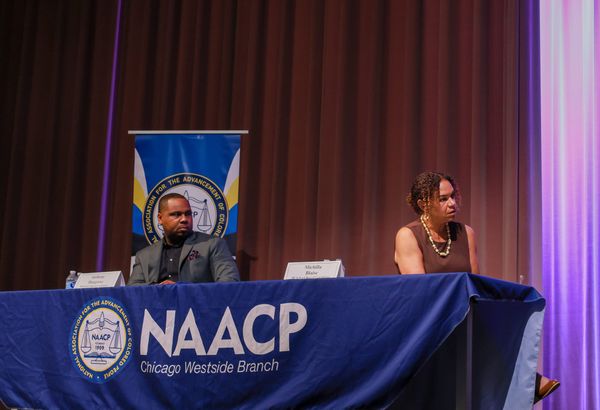
Throughout the forum, hosted by the NAACP Chicago West Side Branch and community partners, moderators pressed both candidates to explain not only what they wanted to change, but how they would fund those changes and measure progress.
Their responses offered voters different approaches to improving schools, although several questions about specific investments and measurable outcomes remained unanswered.
What is District 5A?
District 5A is one of 20 subdistricts that make up Chicago's 10 school board districts. Each district is divided into an A and B subdistrict, with voters choosing one representative from their respective area.
District 5A covers portions of Chicago's West Side, including Austin, Humboldt Park, West Town and Montclare, with areas extending through Garfield Park toward Ukrainian Village.
Students living in the district are also among the least likely in Chicago to attend their neighborhood high school. Fewer than 7% chose their neighborhood high school option, according to CPS data reported by Chalkbeat.
That raises a question for families: What would make more students want to attend schools closer to home?
What does the Board member actually have power over?
The Chicago Board of Education sets districtwide policies and priorities, approves the CPS budget and major contracts, and hires and evaluates the district's superintendent/CEO.
Board members oversee the school system as a whole rather than managing individual schools or classrooms.
That means the person elected in District 5A will not decide every issue at a neighborhood school, but will cast votes on decisions that can affect funding, academic opportunities and services across the district.
School enrollment and access to resources were recurring concerns at the October 1 forum.
Moderators questioned the candidates about chronic absenteeism, disparities affecting Black students, educator diversity and whether neighborhood schools offer the same academic opportunities available elsewhere in Chicago.
The questions also reflected a larger challenge facing CPS: deciding where to invest when its resources fall short of what the state considers adequate funding. According to CPS, the district had 73.3% of the resources needed to meet Illinois' school funding adequacy target in fiscal year 2026.
For families in District 5A, those decisions could affect whether neighborhood schools receive more academic programs, student support services and investments intended to strengthen enrollment.
So, who is running, and what do they want to change?
Two candidates whose names will appear on the District 5A ballot participated in the October 1 forum.
Aaron "Jitu" Brown is the district's incumbent Board member and a longtime community organizer who helped lead campaigns against school closures and for an elected Chicago school board.
LaPamela Williams is an Austin native, Lane Tech graduate and licensed real estate broker seeking her first term on the Board.
Retired CPS teacher Kernetha Jones was removed from the printed ballot following a successful petition challenge but is continuing as a write-in candidate, according to Chalkbeat. Jones did not participate in the forum.
The comparison below is based on Brown's and Williams' public statements, published candidate questionnaires and responses at the October 1 forum.
Swipe sideways to compare both candidates.
Comparison of District 5A school board forum participants
Aaron "Jitu" Brown and LaPamela Williams.
Based on the October 1, 2026 forum and published
candidate questionnaires.
Incumbent Board member, elected in 2024 and
serving since 2025.
Licensed real estate broker seeking her
first term on the Board.
Background
CPS graduate of Kenwood Academy and longtime
education organizer. Helped lead campaigns
against school closures and for an elected
Chicago school board.
Austin native, Lane Tech graduate and
community organizer focused on civic
participation and educational opportunities.
Priorities before the Oct. 1 forum
Diversity, equity and inclusion;
addressing declining enrollment; and
ensuring CPS spends public dollars efficiently.
Financial responsibility, reducing chronic
absenteeism, and improving transparency
and accountability.
School funding priorities
Prioritize historically underinvested
neighborhood schools and expand Sustainable
Community Schools, which connect education
with additional student and family supports.
Direct resources toward student achievement,
establish expectations for investments,
and evaluate whether spending improves
student outcomes.
Budget decisions
Push for additional state funding rather
than cuts that weaken neighborhood schools.
Rejected the premise of accepting budget
trade-offs during the forum.
Review the CPS budget line by line and
redirect spending that is not benefiting
students, while protecting classroom learning.
School closures
Opposes closures. Proposed using available
school space for smaller classes, laboratories,
health services, and other community resources.
Opposes closures, according to her published
questionnaire. At the forum, emphasized
consulting families, educators, principals,
and Local School Councils before closure
decisions are considered.
Chronic absenteeism
Focus on student engagement, youth leadership,
and stronger connections between schools
and their communities.
Speak directly with students and families
to identify attendance barriers and
determine what additional services
may be needed.
Academic opportunities
Expand access to science, mathematics,
world languages, and culturally relevant
instruction within neighborhood schools.
Seek educational opportunities comparable
to those offered elsewhere in Chicago
and involve students and families
in identifying needed resources.
Black students and educators
Expand culturally relevant teaching
and partnerships that prepare more
Black educators to enter classrooms.
Suggested future teacher programs
for students.
Support teacher recruitment pipelines
while tracking their effectiveness.
Emphasized holding CPS leadership
accountable for student outcomes.
Charter schools
Called for stronger charter contracts
and oversight at the forum. Opposes
opening additional charter schools,
according to his questionnaire.
Wants schools evaluated on performance.
Would consider new charter schools
only with demonstrated community need,
sustainable funding, and a clear
educational plan.
Artificial intelligence
Expressed concern about AI use among
younger students. Favored guardrails
and more supervised use as students
get older.
Said AI should not replace teachers.
Called for community conversations
about appropriate ages, uses,
and standards.
Measuring progress
Pointed to regular reports on
Sustainable Community Schools.
Did not provide a numerical two-year
target for the initial funding
question.
Emphasized reviewing performance
data and following up with CPS
leadership. Did not provide a
numerical two-year target for
the initial funding question.
Sources: October 1, 2026 District 5A candidate forum;
published candidate questionnaires from the
Chicago School Board Voter Guide, a collaboration
of WBEZ, the Chicago Sun-Times, Chalkbeat,
and Block Club Chicago. The table summarizes
candidates' stated positions, not independently
established outcomes.
The comparison offers a quick look at where the candidates stand. But several issues raised during the forum deserve a closer look.
Now, why does this matter for my child's school?
Decisions made by the Board can shape the resources, programs and services students encounter every day.
What happens when CPS doesn't have enough money?
One of the forum's most revealing exchanges concerned how candidates would handle financial constraints.
The approved budget included an assumption of $150 million in additional state revenue. At the time of approval, CPS warned that it could need to make midyear reductions if some or all of that money did not materialize.
Asked what financial action they would prioritize, Williams said she would review the budget "line by line" to determine whether spending was benefiting students.
She argued that funds not supporting student success should be reconsidered and potentially directed toward other investments.
Brown challenged the premise of accepting trade-offs that could harm neighborhood schools.
"In my mind there are no trade-offs," he said.
He argued that Illinois should provide additional resources rather than requiring schools that have experienced decades of disinvestment to absorb further reductions.
Brown has also separately advocated reducing administrative overhead, according to his published campaign priorities.
Neither candidate named specific cuts or a detailed financial plan. Williams proposed redirecting funds toward student needs, while Brown called for the state to contribute its fair share.
Board members can approve district spending priorities, but securing additional state funding requires action beyond CPS.
Will neighborhood schools close after the current moratorium expires?
Brown opposed closing neighborhood schools in Black communities and pointed to Sustainable Community Schools as an alternative. He suggested that buildings with available space could offer smaller class sizes, health services, science laboratories and other programs that benefit students and surrounding neighborhoods.
Williams emphasized involving families and school communities long before any potential closure decision. She called for discussions with parents, teachers, principals and Local School Councils to understand why a school might be considered for closure and what students need.
Brown explicitly opposed closing schools in Black communities. Williams emphasized consulting the school community before considering a closure.
Why are students missing so much school?
At Michele Clark Academic Prep Magnet High School, where the forum took place, CPS' online school profile lists a chronic absenteeism rate of 88.8%. That means nearly nine in 10 students in the reported period missed at least 10% of the school year, including excused and unexcused absences.Copy clean text
The rate shows how widespread absences are, but it does not explain why individual students miss school. Candidates were asked which barriers CPS should investigate, what action they would support and what attendance benchmark they would expect within two years.
Williams said the district should begin by talking with students and families to understand why children are missing school and what additional services might help.
Brown argued that attendance is closely connected to student engagement. He described his experience coordinating community school programs and said attendance improved when students had a voice in shaping activities and opportunities.
Neither candidate offered the numerical two-year attendance goal requested by the moderator.
How will voters know whether the next Board member is delivering?
Throughout the forum, moderators pressed both candidates to identify specific investments, funding sources and ways to measure progress.
They asked how the Board should evaluate academic outcomes, track the recruitment and retention of Black educators, and monitor disparities affecting Black students with disabilities.
Both candidates described priorities and approaches, but neither consistently provided the specific benchmarks or implementation details requested. Candidates were also answering under short time limits.
Those unanswered questions provide an opportunity for voters to revisit campaign commitments after the election.
Will more academic opportunities become available in neighborhood schools? Will chronic absenteeism decline? Will CPS expand access to qualified educators and student support services? And will the Board publish enough information for families to evaluate whether those investments are working?
The next District 5A representative will have one vote on Chicago's 21-member Board of Education.
For residents, the commitments made during the campaign offer a starting point for asking what has changed once that representative takes office.
How and when do I vote?
Election Day is Tuesday, November 3, 2026, and polls are open from 6 a.m. to 7 p.m.
Early voting began downtown on October 1 and expands to all 50 Chicago wards on October 19.
District 5A voters will see Brown and Williams listed on the ballot. Jones is running as a write-in candidate. Chicago voters will also vote in the separate citywide Board president race.
This story is available for republication under a Creative Commons Attribution-NoDerivatives 4.0 International License. You may republish this article with attribution to the author and 15 West, but you cannot modify the text.
NaBeela is a Chicago-based journalist writing about what's possible. She's a fierce advocate of the arts and brings people together around literature and culture. Read more: nabeelawashington.com
Comments
District 5B school board candidates Anthony Hargrove [LEFT], and Michilla “Kyla” Blaise participate in a Sept. 17 candidate forum hosted at Collins Academy STEAM High School. | NaBeela Washington/15 West
El graduado de secundaria de primera generación Forylan Suarez y su familia enfrentaron numerosas barreras sistemáticas para navegar el sistema de educación pública. | Max Herman/Borderless Magazine