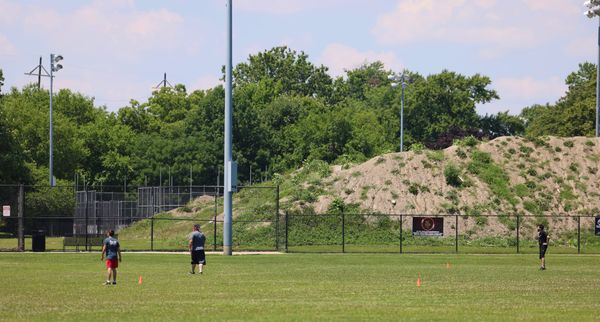
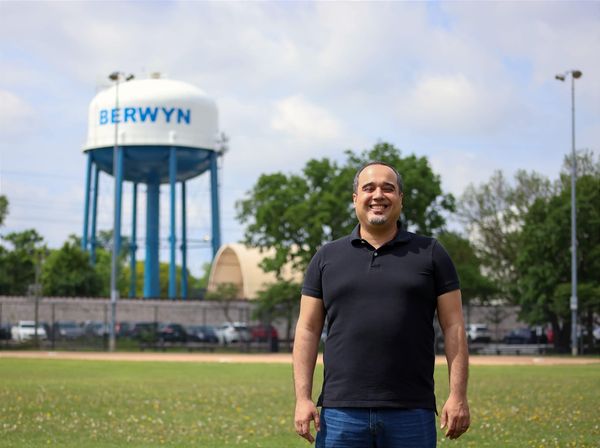
David Avila asked the question while opening Berwyn's newest athletic field. Just steps away, a pile of dirt marks a flood relief project that remains on hold.
Janura Park dirt pile as of July 12, 2026. | NaBeela Washington/15 West
Bonnie Bolger lived at the corner of East Avenue and Pershing for 40 years without a drop of water in her basement. In August 2025, it flooded for the first time.
She lost everything in her finished basement. Insurance didn't cover the damage, she said, and she received no assistance from the city. Then, this spring, water sprayed through her basement windows while she and her 22-year-old son ran outside in the dark to check whether the street drains were clogged.
“This is horrible! … just blew my mind. I told Public Works the sewer wasn’t covered with debris. We checked and tried to push the water along but it was too late.”
Bolger's experience is no longer unusual. Her sister, who lives near 35th Street and Wesley Avenue, has dealt with basement flooding nearly every year for five decades, she said.
Across Berwyn, residents describe a city where flooding has quietly become the new normal: basements soaked, streets swamped, and sewers overwhelmed by storms that once would have been manageable.
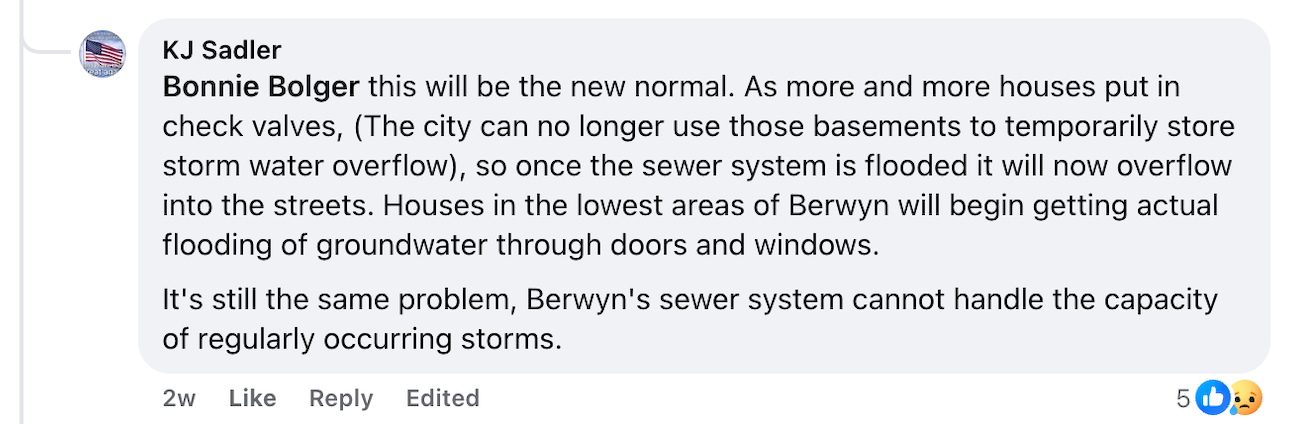
In the same Facebook thread, Connie Arroyo described her street flooding on both sides simultaneously, with the sewers clogged and useless. Another resident, KJ Sadler, warned that as more homeowners install check valves to protect their own basements, floodwater has nowhere to go but into the streets and, eventually, through the doors and windows of homes in the lowest-lying areas.
Resident shares their flooding experiences in the Berwyn Community Facebook group.
City officials have known this for years. Berwyn's own 2018 Stormwater Management Plan documented seven major flooding events between 2010 and 2017. Records obtained by 15 West through a public records request to the City of Berwyn showed a single storm in April 2013 generated $1.27 million in FEMA assistance payments to 303 Berwyn households.
The plan identified Janura Park, a community park at 28th Street and East Avenue, as a priority site for underground stormwater detention infrastructure expected to serve approximately 24 acres of residential neighborhood along Euclid Avenue, Wesley Avenue, and Clarence Avenue—an estimated 200 or more homes. Internal city emails obtained by 15 West show an early draft of the city’s May 2026 public update also described the project as benefiting more than 200 homes. The version ultimately released to the public instead described it as serving “47 participating homes.”
15 West asked the city to clarify the relationship between the two figures.
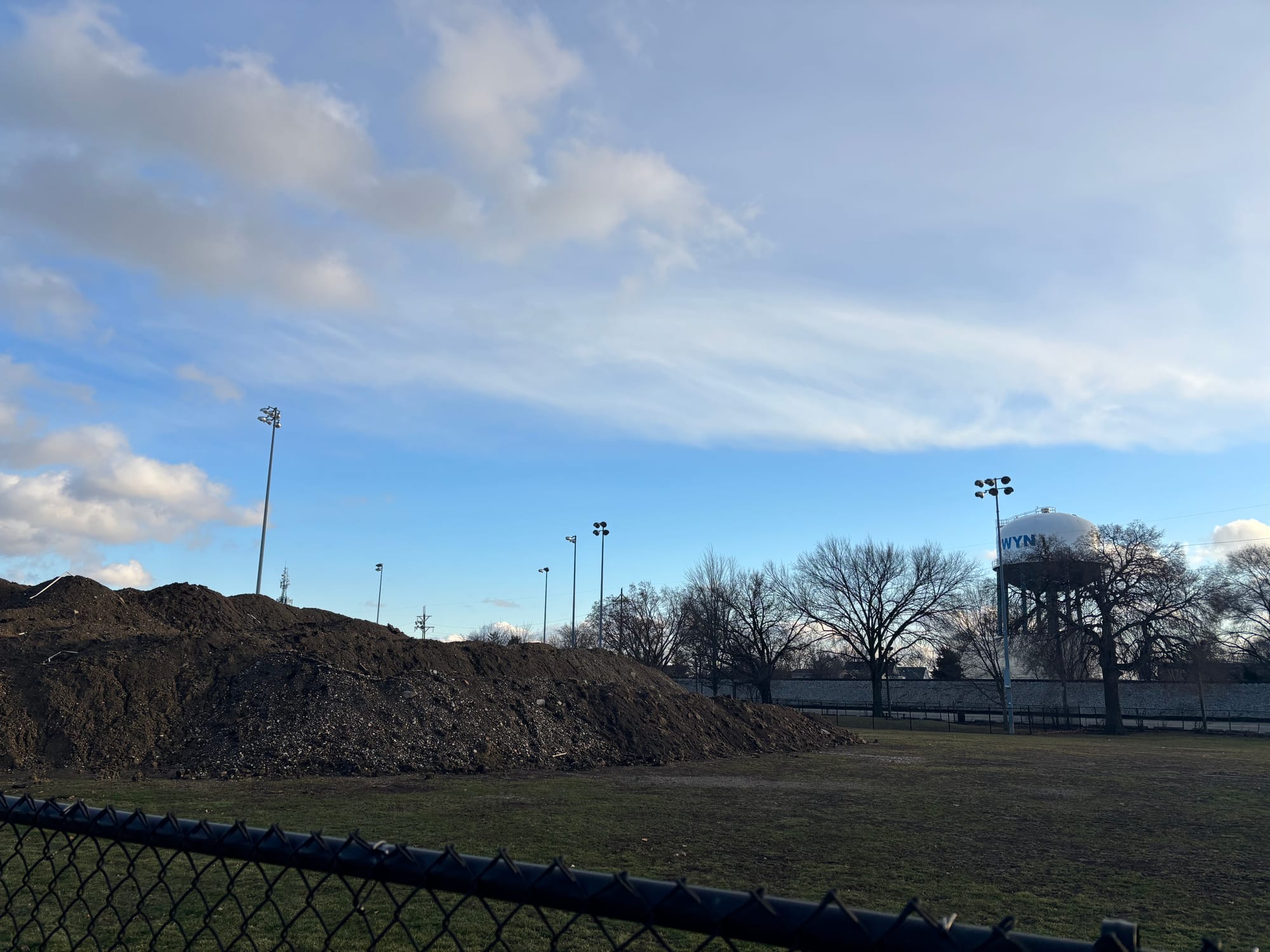
That was 2018. Seven years later, the detention system remains on hold. The most visible sign of the unfinished project is a large pile of excavated soil sitting in Janura Park.
The dirt pile on January 10, 2026. | NaBeela Washington/15 West
A New Field. An Old Dirt Pile.
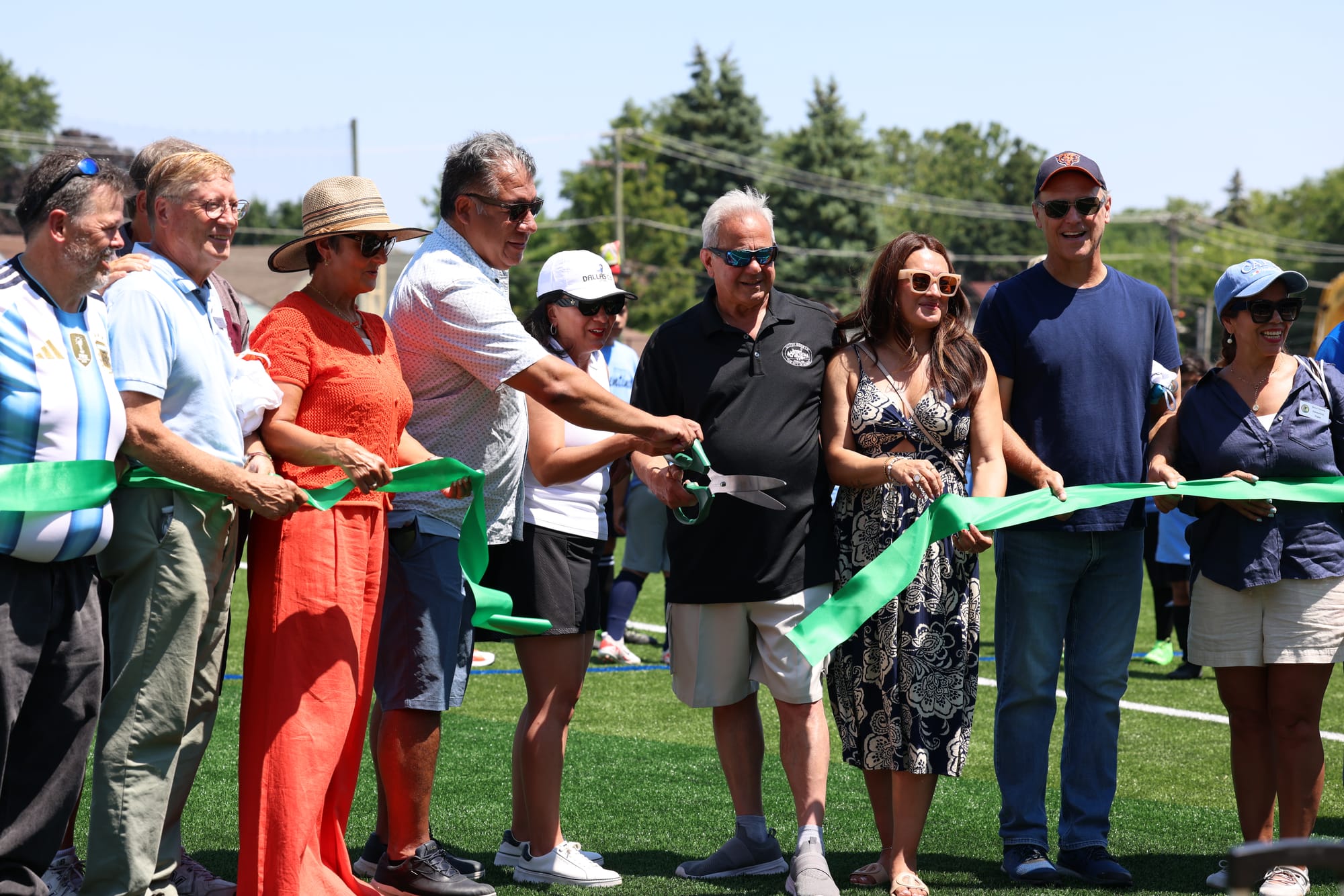
On July 12, 2026, Mayor Robert Lovero stood at a ribbon-cutting ceremony for the new Berwyn Community Field, an artificial turf athletic field at 29th Street and East Avenue, just steps from Janura Park. The mood was bright. In front of him, Township Supervisor David Avila, the project's biggest financier, described Berwyn’s need for more places for children to play.
[LEFT] Tony Martinucci giving remarks. [RIGHT] Moment of ribbon cutting. | NaBeela Washington/15 West
First youth league game after ribbon cutting. | NaBeela Washington/15 West
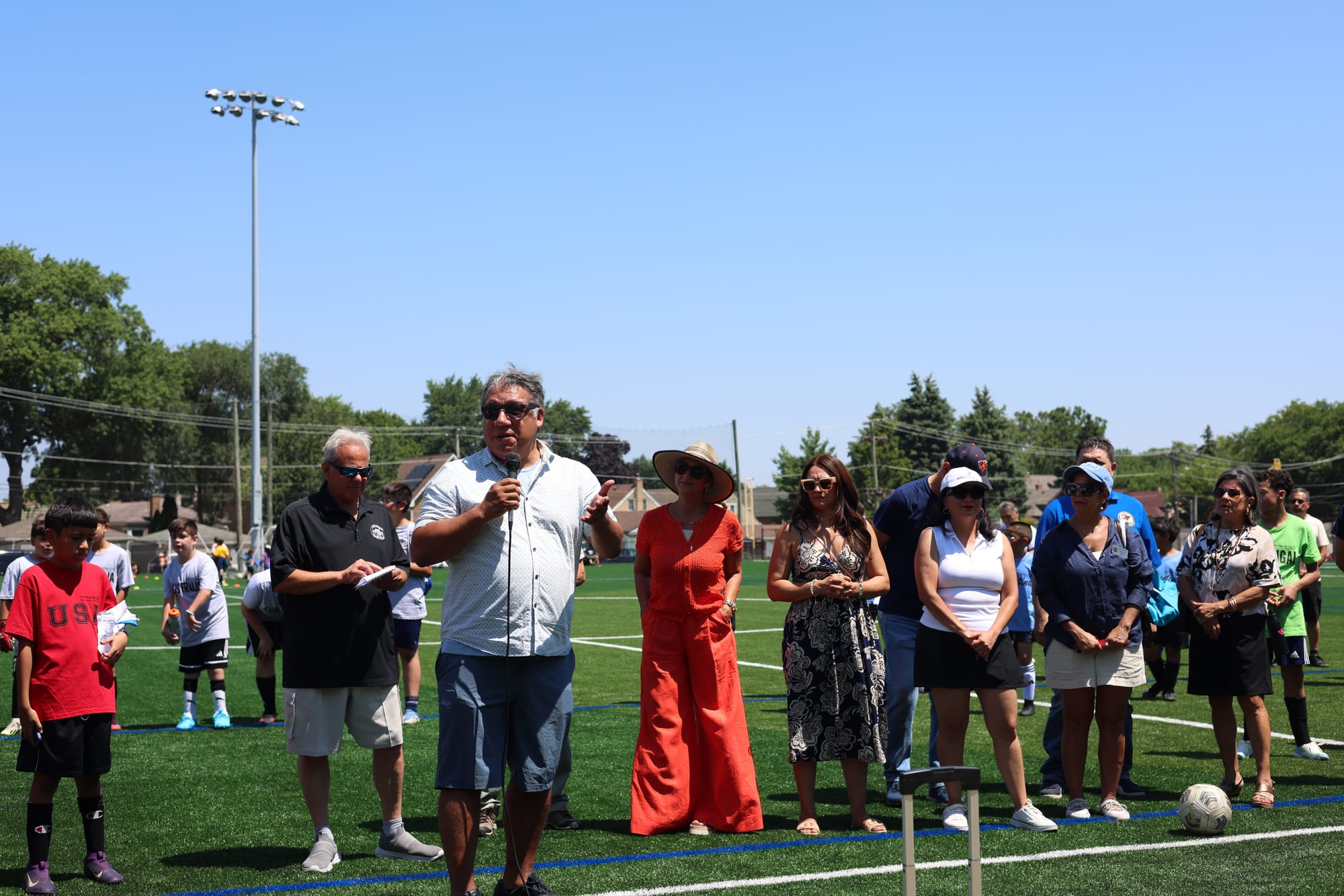
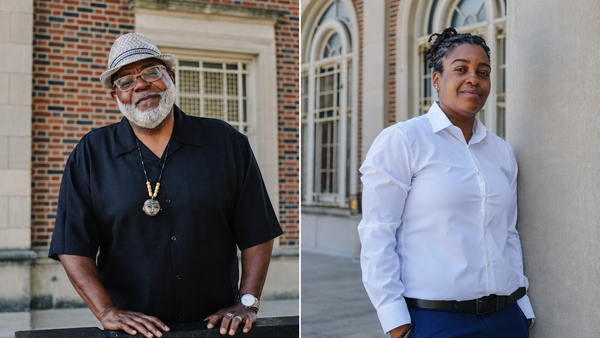
“Where are kids supposed to go?” Avila said at the ceremony. “Where can they exercise and play soccer, play the games they love?” The new athletic field answers that question for hundreds of Berwyn families. Funded through a township partnership and championed by Mayor Robert Lovero, Recreation Director Anthony "Tony" Martinucci, and Township Assessor Jacqueline Pereda, the field is expected to serve hundreds of young athletes each season.
David Avila speaking at the “community field” ribbon-cutting | NaBeela Washington/15 West
Just steps away, however, another city project remains unfinished.
Its most visible sign is a large pile of excavated soil moved from the athletic field into Janura Park, where it has sat while the city's long-planned flood mitigation project waits for federal funding.
At the ribbon cutting, Martinucci explained what the pile is for.
“What's going to happen is there's a water reclamation project for storm sewers, that's going to go under there,” he said, “and it's going to be their grant—or whatever—is then going to pay to put two, maybe three, T-ball fields.”
The soil first appeared in November 2025.
Residents would wait nearly six months before the city publicly explained why it was there.
“I Do Not Have Any Information On This”
The City of Berwyn's May 19 press release described the project as "ongoing," noted that permits and clearances had been finalized, and explained near the end that construction had stalled because federal funding had been frozen following disruptions at the Department of Homeland Security. The $5 million grant has been frozen since at least early 2026.
Records obtained by 15 West show city officials had been discussing Janura Park as a temporary “dumpsite” months before residents were publicly told why the soil had been moved there.
The records also show that contractor Team REIL Inc. had been coordinating with city officials as early as August 2025 about using Janura Park as a temporary dump site for the soil. In an August 29, 2025, progress report, Team REIL Assistant Project Manager Monica Thompson noted that engineers had met with city staff “to design a dumpsite at Janura Park” and that the city had agreed to provide trucks to haul soil there. A September 5th update from Team REIL Project Manager Jeff Koehler noted a tentative start date of September 15th for the soil move.
The emails were copied directly to Mayor Robert Lovero's city email account.
When 15 West asked who authorized moving the soil to Janura Park, Senior Engineer Nicole Campbell responded: “I do not have any information on this.”
Yet emails obtained by 15 West show city officials had discussed using Janura Park as a temporary "dumpsite" months earlier.
The Question No One Is Answering
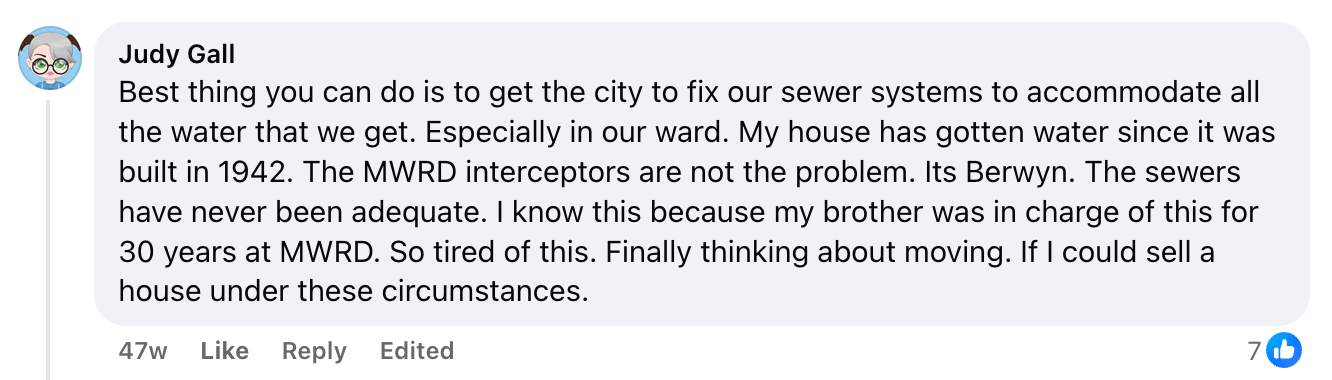
Judy Gall, a Berwyn resident whose family has dealt with flooding since her house was built in 1942, put it plainly in a Facebook comment:
Resident shares their flooding experiences in the Berwyn Community Facebook group.
For residents like Gall and Bolger, the stalled Janura Park project is the difference between a dry basement and a ruined one. Between a home that can be sold and one that cannot.
The $5 million grant that would fund the underground detention system, and eventually the T-ball fields Martinucci described, is tied up in a federal funding freeze affecting FEMA Hazard Mitigation Grant projects nationwide following disruptions at the Department of Homeland Security. The City of Berwyn says it is waiting for updates from contractors and project partners.
No timeline has been provided for when construction will resume.
"Nothing has improved," Bolger said. "And no one seems to be doing anything about it."
15 West requested comment from Mayor Robert Lovero's office and the City of Berwyn. We will update this story if city officials respond or if a construction timeline is announced.
Republish This Story
This story is available for republication under a Creative Commons Attribution-NoDerivatives 4.0 International License. You may republish this article with attribution to the author and 15 West, but you cannot modify the text.
We believe readers should be able to review the same documents we use in our reporting. Details in this story are based in part on public records obtained by 15 West through a request to the City of Berwyn.
Those records include:
Emails between city staff and contractors discussing the Janura Park soil relocation
Progress reports documenting plans for the temporary soil stockpile
Internal communications surrounding the city's May 2026 public update
Documents related to the stalled Janura Park flood mitigation project
Resources for Berwyn homeowners dealing with flooding
Report flooding to the City of Berwyn
The city asks residents to report flooding, sewer backups, and storm damage through its online flood reporting form. Reports help the city document where flooding occurs and may inform future planning.
Consider downloading the Polycam app to take scans of your property.
Save receipts for emergency repairs and damaged belongings.
Contact your insurance company as soon as possible.
*Documentation can be important for insurance claims and any future disaster assistance programs.
Stay safe
Floodwater can hide open manholes, electrical hazards, or fast-moving currents.
Avoid walking or driving through standing water whenever possible.
Keep children away from flooded streets and alleys.
Wait until it is safe before entering a flooded basement if electrical systems may have been affected.
Check on neighbors
Storms can be especially difficult for older adults and residents with mobility challenges.
The City of Berwyn encourages residents to check on neighbors who may need assistance.
Senior Services
English: (708) 788-2660 ext. 6489
Ayuda en Español: ext. 6492
Know something we don't?
Have you experienced repeated flooding? Have photos of Janura Park before or after the soil was moved? Have documents or information related to the stalled flood mitigation project?
What can Berwyn homeowners do to reduce flooding while they wait?
Some residents are taking steps to reduce water around their homes.
Berwyn resident Ian Feigle said planting trees and installing rain gardens has helped reduce water infiltration on his property. He said he has not experienced basement seepage in more than a year after making those changes.
Experts also recommend considering:
Planting native trees and deep-rooted vegetation
Installing rain gardens to absorb stormwater
Keeping gutters and downspouts clear
Directing downspouts away from foundations where appropriate
Considering a check valve or backflow prevention device if recommended for your property
These measures cannot replace city stormwater infrastructure, but they may help reduce localized flooding while larger mitigation projects remain delayed.
NaBeela is a Greater Chicago-based photographer and journalist writing about what's possible. She's a fierce advocate of the arts and brings people together around social change and accessible education. Read more: nabeelawashington.com
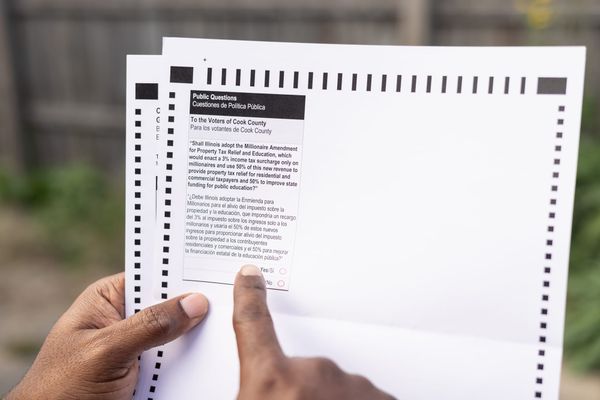
A voter reviews the Cook County public question asking whether Illinois should impose a 3% surcharge on income above $1 million and divide the revenue between property-tax relief and public education. | NaBeela Washington/15 West