Chicago voters will weigh in on taxing millionaires for schools. How the money is divided matters, too.
Two advisory questions on Chicago ballots ask voters whether Illinois should tax millionaires to support public education. Advocates and policy experts say raising more money is only part of the solution. Where that money goes could determine whether it closes existing school funding gaps.
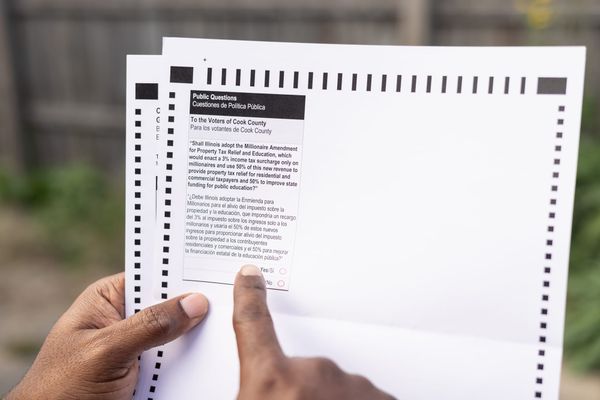
A voter reviews the Cook County public question asking whether Illinois should impose a 3% surcharge on income above $1 million and divide the revenue between property-tax relief and public education. | NaBeela Washington/15 West
When Maddy Murray taught English at Lincoln Park High School, there were days when her classroom did not have enough desks for every student. One student would sit in Murray's teacher chair. Murray would go without one.
For Murray, now director of Grassroots Engagement and Campaigns at the Partnership for Equity and Education Rights, or PEER Illinois, the story illustrates something that can get lost when school funding is discussed through percentages and formulas.
Underfunding can mean a missing desk. It can mean fewer counselors, librarians, or social workers. It can mean uncertainty over whether a trusted teacher will still have a job halfway through the school year.
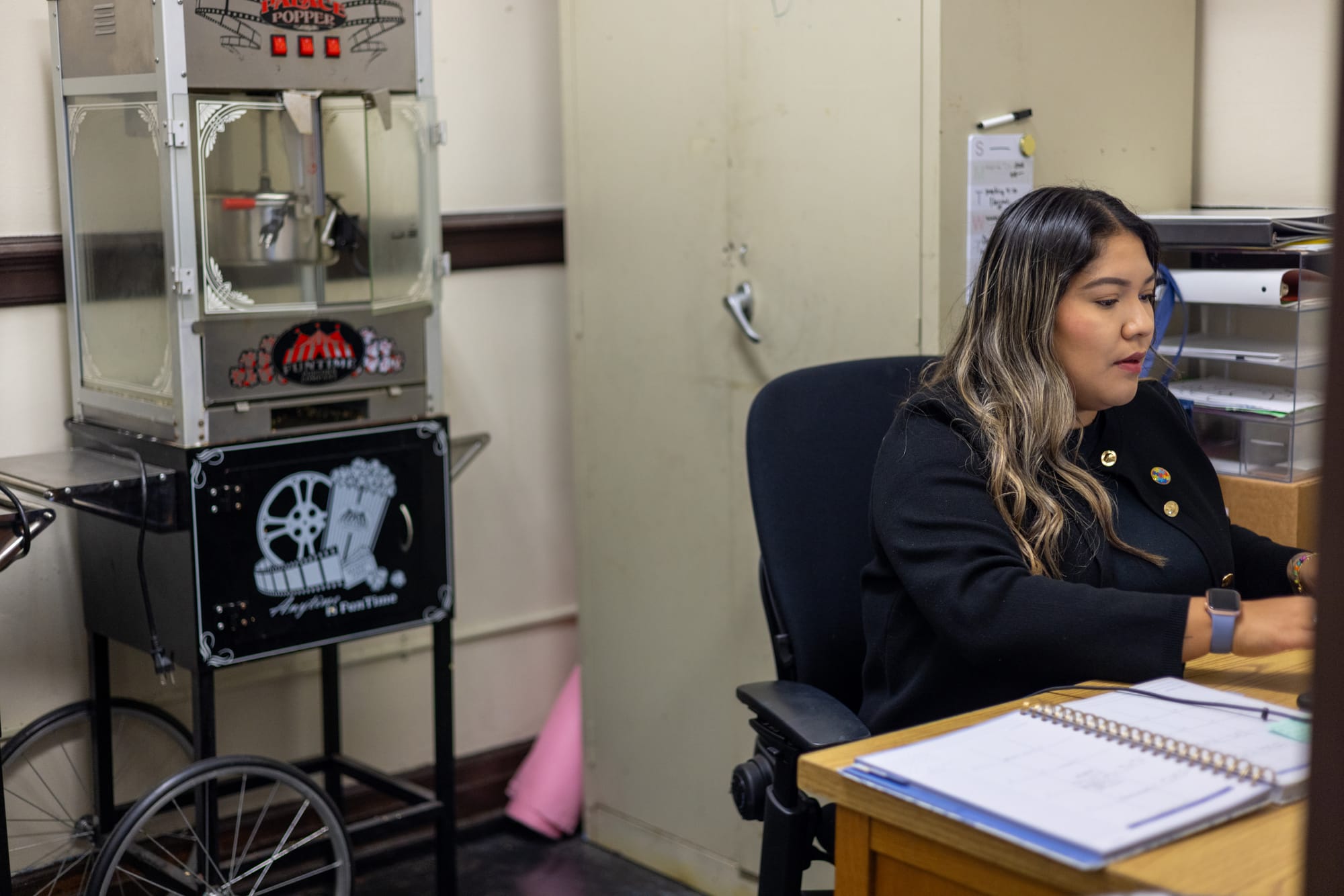
Laura Casimiro seated in her office. | NaBeela Washington/15 West
“If that teacher is the one person that you trust in the school, then that's a really big impact,” Murray said.
This November, Chicago voters will weigh in on two advisory questions proposing how Illinois could bring more money into public education: taxing income over $1 million at a higher rate. One, approved by the Cook County Board of Commissioners, asks whether Illinois should impose a 3% surcharge on income above $1 million and use half of the new revenue for property-tax relief and half to improve public-school funding. The Chicago Board of Education separately approved a question asking voters: “Shall Illinois use revenue from a surcharge on millionaires to increase funding to public schools?” The Board said the nonbinding question is intended to gauge public opinion and guide future decision-making.
Neither vote would create a new tax or immediately send money to schools.
But the questions arrive as lawmakers and education advocates debate whether Illinois needs new revenue to adequately fund its public schools and, just as importantly, how that money should be distributed.
Wait, which millionaire-surcharge proposal is which?
Cook County advisory question Asks voters whether Illinois should impose a 3% surcharge on income above $1 million, with half of the revenue going to property-tax relief and half to public education.
Chicago Public Schools advisory question Asks Chicago voters whether Illinois should use revenue from a surcharge on millionaires to increase funding for public schools.
HJRCA 21 A proposed amendment to the Illinois Constitution that would create a 3% surcharge on net income above $1 million. Half of the revenue would go to property-tax relief, and half would be distributed to school districts on a per-pupil basis.
The key difference: The two ballot questions are nonbinding. They measure public opinion but do not create the tax or send money to schools. HJRCA 21 is the state-level proposal that could actually change Illinois tax policy if it advances through the constitutional amendment process.
A tax proposal and an unresolved question
In Springfield, lawmakers are considering HJRCA 21, a proposed Illinois constitutional amendment that would impose a 3% surcharge on the portion of an individual's net income above $1 million. The advisory questions do not formally advance HJRCA 21, but their results could give lawmakers a measure of public support for pursuing a proposal like it.
Half of the revenue would go to property tax relief. The other half would be distributed to school districts solely on a per-pupil basis, meaning districts would receive the same amount for each student regardless of how well-funded the district already is.
The proposal was re-referred to the House Rules Committee on July 1. Rep. La Shawn Ford is its chief House sponsor. Advocates say the two nonbinding ballot measures voters face this fall could give lawmakers and other public officials an important measure of public support for such a proposal.
Illinois would not be the first state to turn to high earners for additional education funding. Massachusetts voters approved a constitutional amendment in 2022 imposing a 4% surtax on taxable income above $1 million, with the revenue dedicated to education and transportation. The state’s fiscal year 2027 budget includes $2.7 billion from the surtax, including about $1.73 billion for education programs such as K-12 funding, universal school meals, child care, and free community college. Massachusetts offers evidence that such a tax can generate substantial new education revenue, but it does not resolve the question Illinois advocates are raising about HJRCA 21: how those dollars should be distributed among school districts.
The per-pupil distribution has emerged as a central concern among several parents, education advocates, and policy experts interviewed by 15 West.
They generally agree that Illinois needs additional education revenue. But they questioned why new money would bypass the state's existing evidence-based funding formula, which was created specifically to direct more state dollars toward districts with greater needs.
Elaine Gaberik, director of policy analysis at the Center for Tax and Budget Accountability, said her concern is not with asking high-income residents to contribute more.
“I believe that a progressive tax that adds a higher rate to those who are earning higher incomes would be a good thing for Illinois,” Gaberik said. “I think that investing more in education would be a good thing in Illinois.”
Her concern is what happens next.
“I believe a per-pupil basis for distributing the funds undermines equity,” she said.
Illinois already has a formula designed around need
Illinois adopted its evidence-based funding, or EBF, formula in 2017.
Rather than assuming every school district needs the same amount of money, the formula calculates an “adequacy target” for each district based on the resources it would need to serve its students. Those calculations account for factors including the number of low-income students, English learners, and students receiving special education services, as well as resources such as instructional materials and technology.
New state funding is then weighted toward districts further from their adequacy targets.
Gaberik described the formula as one of the stronger frameworks in the country for addressing both adequacy and equity.
“The issue is that the money hasn't really been there,” she said. CPS illustrates this gap.
According to CPS, the district has 73.3% of the resources Illinois' funding formula determined it needed to be adequately funded in fiscal year 2026. The district estimates it would need another $985 million to reach the state's 90% adequacy goal.
Under HJRCA 21, however, the education portion of the millionaire surcharge would not be distributed through that needs-based formula. Each school district would instead receive money according to its number of students.
That means a student in a district already at or above adequate funding would generate the same new allocation as a student in a district that remains substantially underfunded.
“There are some very well-funded public school districts out there who would be getting the same amount through this proposal per student as the less well-funded districts,” Gaberik said.
Equal is not always equitable
Beatriz Diaz-Pollack, director of PEER Illinois, said Illinois has already confronted this question once. Before the evidence-based funding formula, the state school finance system relied more heavily on approaches that did not sufficiently account for differences in what individual districts and students needed.
“Every student in every school system has different needs,” Diaz-Pollack said. Illinois is also starting from a system with longstanding funding disparities, she said.
“If we add an additional dollar amount on top of that, that's just going to maintain that inequity.”
PEER supports finding new revenue for public education, including approaches that ask wealthy residents and corporations to contribute more rather than placing additional burdens on working families. But the organization believes the distribution side of the equation matters just as much.
Diaz-Pollack said one option would be to place new millionaire-surcharge revenue into the evidence-based funding system, allowing the existing tiers to direct a larger portion toward districts further from adequacy. “Folks may not know that we actually moved away from a per capita funding system because of inequity,” she said.
Illinois schools depend heavily on local property taxes, which means communities with greater property wealth have historically been able to raise more money for their schools than communities with smaller tax bases. Gaberik said that dependence helped produce large disparities before the evidence-based funding formula was adopted.
Diaz-Pollack said those differences follow historically racialized patterns of housing and wealth in Illinois, making the way new education dollars are distributed especially important.
What underfunding looks like outside a spreadsheet
For families and educators, those gaps can be visible in smaller ways. Murray remembers not having enough desks. She and Diaz-Pollack said school communities also report concerns about class size, paraprofessionals, social workers, counselors, librarians, nurses, bilingual education, technology, arts programs, and extracurricular activities.
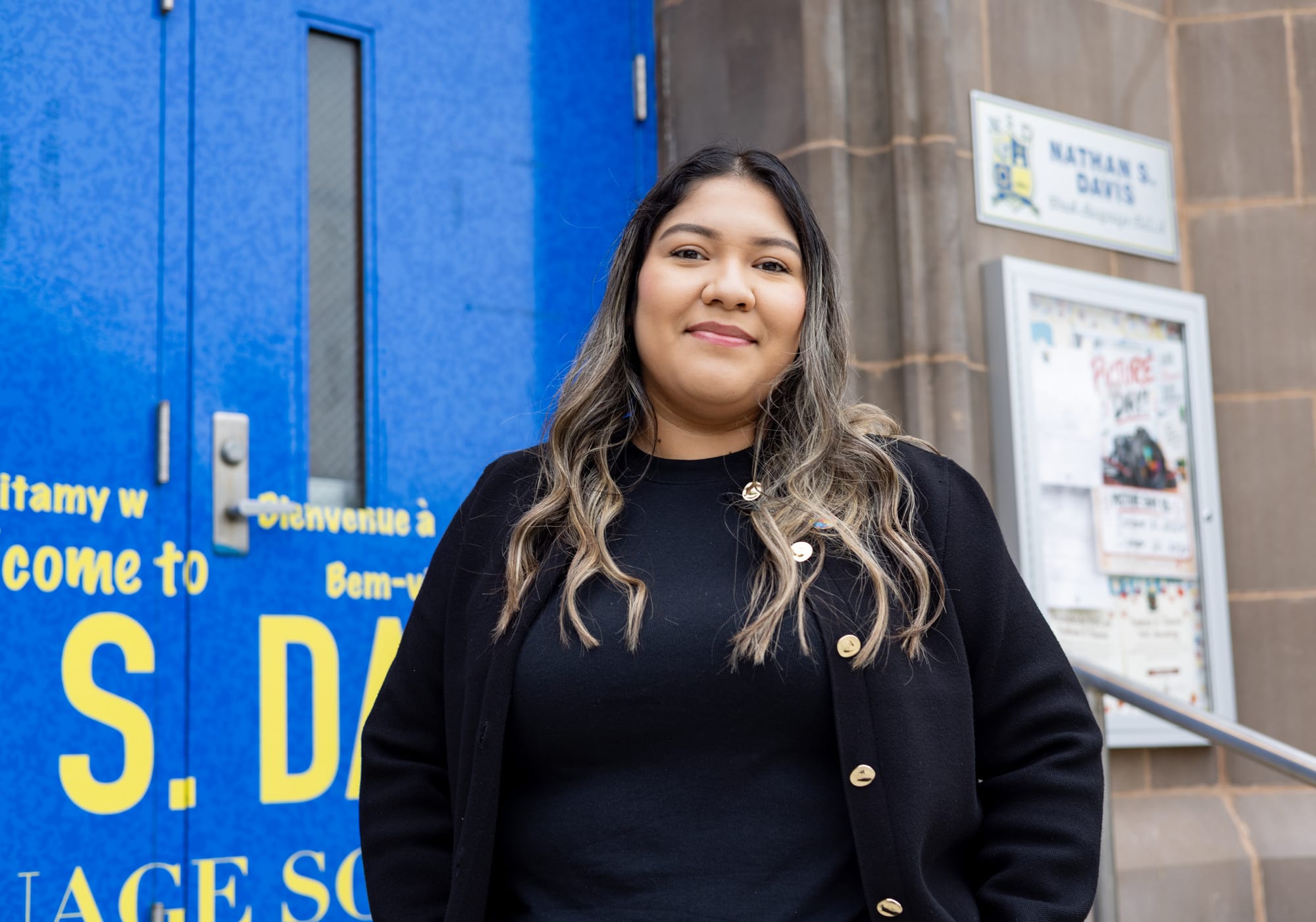
Laura Casimiro. | NaBeela Washington/15 West
Laura Casimiro sees school funding gaps both as a parent and from inside the classroom. Her two sons attend different schools, and her younger son has an individualized education program, or IEP.
As she begins thinking about his next school, Casimiro said one of her biggest concerns is finding a school with staff prepared to meet his needs. She said the number of schools she feels equipped to consider is already limited.
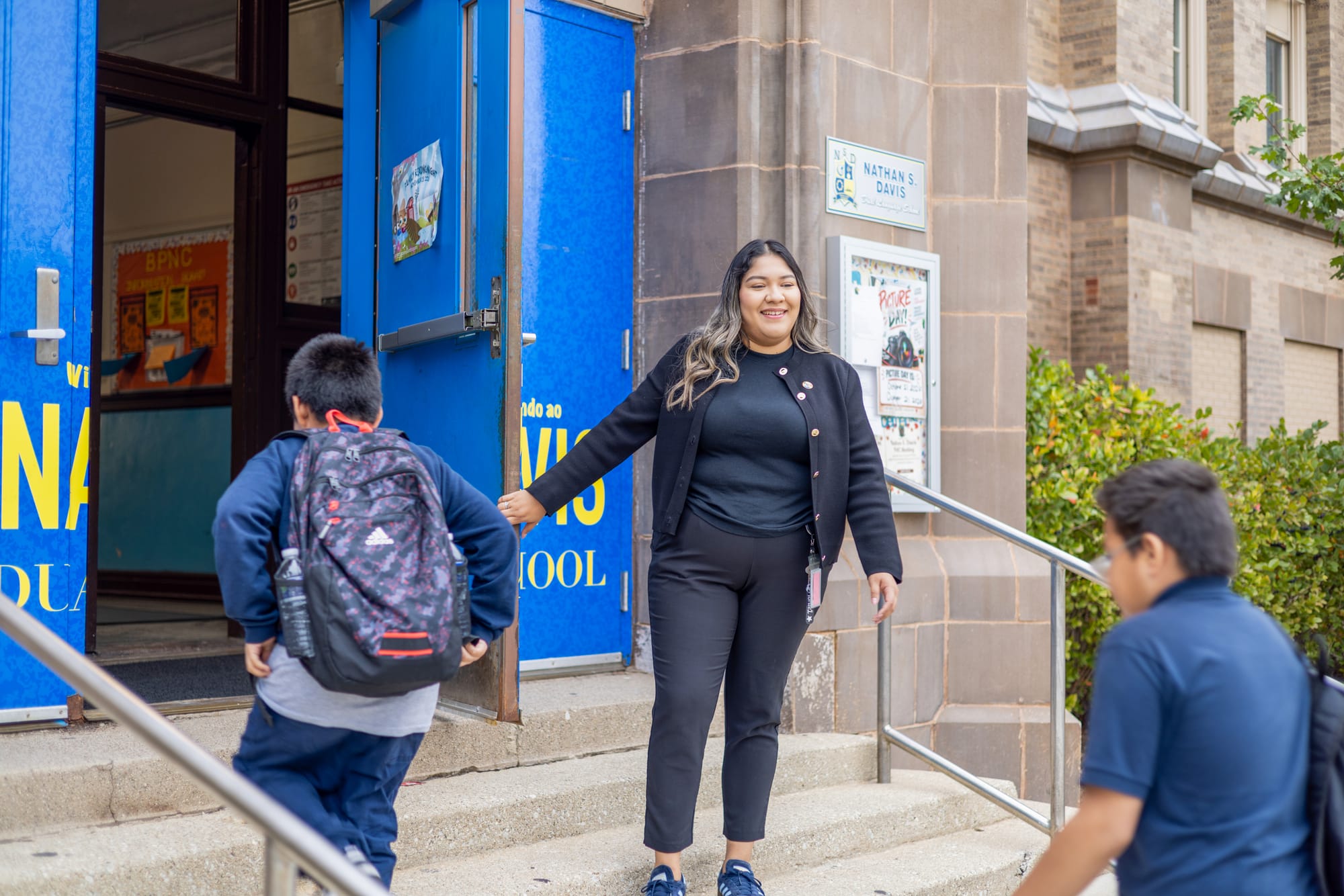
At the same time, Casimiro works as a parent mentor coordinator in Brighton Park and regularly sees classrooms where teachers need additional support. In one third-grade classroom, she said she has stepped in to help even though she is not a licensed teacher.
Laura Casimiro welcoming students arriving for school. | NaBeela Washington/15 West
“This is my child, and I want my child to have the best,” Casimiro said.
Cassie Creswell, executive director of Illinois Families for Public Schools and a CPS parent, sees it in her own children's schools.
She describes schools scrambling for Chromebooks, losing positions such as restorative justice staff, and relying on parents and school communities to continuously raise money. There are limits to what gaps families can close themselves.
“No amount of fundraising is ever going to get you even a teacher position or a new HVAC system,” Creswell said. Creswell recalled her daughter and her soccer teammates traveling to play at a suburban high school, marveling at the facilities, down to how nice a bathroom could look compared with what they were accustomed to. Her own child's school is relatively well resourced by CPS standards, Creswell said. Still, those comparisons can make differences between districts difficult to ignore. For Creswell, the state's existing funding formula is not the biggest problem. “The real problem is that we need revenue to put into that formula,” she said.
So, what does voting “yes” actually do?
For voters, the distinction between an advisory question and a binding measure is important. A “yes” vote on either November question would not enact HJRCA 21. It would not immediately increase the amount of money available to CPS. And it would not create a millionaire surcharge.
The Cook County resolution says its referendum is intended to document residents' opinions and give public officials and state legislators information as they consider related policy. The Chicago Board of Education similarly describes its millionaire surcharge question as nonbinding and intended to guide future deliberations. But advocates say that does not make the questions meaningless.
Creswell said lawmakers remain cautious after Illinois voters rejected a separate graduated income tax constitutional amendment in 2020. A favorable advisory vote, she said, could give advocates something tangible to bring back to Springfield. Even though the referenda are nonbinding, “they do show what voters think about these issues,” Creswell said.
Diaz-Pollack similarly describes the questions as a way for residents to put their views on the record and give policymakers another data point about public support.
She said voters need more than a sentence on a ballot to understand what they are being asked. “What voters really need is context,” Diaz-Pollack said. And that context includes both sides of the policy equation.
Illinois could raise money for public schools. The state could also decide how to distribute it.
These are not separate conversations for Gaberik, Diaz-Pollack, and Creswell. Gaberik said additional education funding should move through the equity-focused system Illinois already created. “Any additional state funding that is intended for K-12 education should be put through the evidence-based funding formula,” she said. The November advisory questions will not settle that debate, but they could tell policymakers something about whether voters want them to keep having it.
This story is available for republication under a Creative Commons Attribution-NoDerivatives 4.0 International License. You may republish this article with attribution to the author and 15 West, but you cannot modify the text.
NaBeela is a Chicago-based journalist writing about what's possible. She's a fierce advocate of the arts and brings people together around literature and culture. Read more: nabeelawashington.com