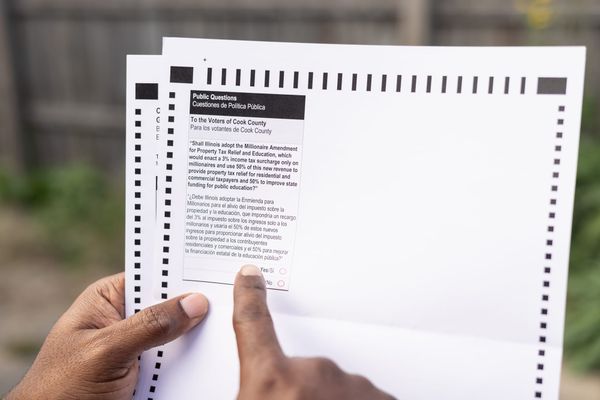
Ballots can include candidate names, district numbers, instructions like “Vote for ONE,” judges, and public questions. This guide breaks down what some of that language means before you vote.
The examples below are made up. Your ballot may look different depending on where you are registered to vote.
How to use this guide
The numbered circles connect parts of the example ballot to the explanations below.
Start with the race
Example ballot
Made-up names are used to show how a race may be organized.
Member of the School Board
1
Office or race
The position you are voting for.
District 5B
2
District
The area this race represents.
Vote for ONE
3
How many choices?
The maximum number of candidates you may select.
Jordan Sample
4
Your choices
The candidates or options available in this race.
Avery Example
Write-in: __________________
5
Write-in
A place to enter an eligible candidate whose name is not printed.
1 Office or race
This tells you what position you are voting for. A single ballot can include races for different levels of government, along with judges and public questions.
2 District
Some elected officials represent a specific part of a city, county or state.
That means two people who live in the same city may not have exactly the same ballot.
3 How many choices?
The words “Vote for ONE” tell you how many choices you can make in that race.
Vote for ONE means you can choose up to one candidate. Vote for TWO means you can choose up to two.
Check this instruction before marking your choice.
4 Your choices
These are the candidates or other choices available in the race.
Follow the instructions on your ballot or voting machine to mark your selection.
5 Write-in
Some races include a place to vote for a write-in candidate whose name is not printed on the ballot.
If you want to cast a write-in vote, follow the instructions provided with your ballot or ask an election judge for help.
What if I don't want to vote in every race?
Yes.
You do not have to make a choice in every race. Leaving one contest blank does not cancel the votes you make elsewhere on your ballot.
Public questions look different
Some parts of your ballot may ask you to vote Yes or No instead of choosing a candidate.
Example
Example ballot
This question is made up for this guide.
Public Question
Shall Example County establish a program to improve public parks?
6 Read the question Read the full wording before choosing Yes or No.
YES
NO
6 Read the question
Public questions can be longer than candidate races, so read the full wording before making your choice.
The questions you see may also depend on where you live.
Before you cast your ballot
Take a moment to review your choices.
- Make sure you did not select more candidates than the race allows.
- Check that your selections match what you intended.
- Look through the entire ballot, including additional pages or screens.
- Review any public questions you want to vote on.
Something look wrong? If you make a mistake or have a question, ask an election judge for help before you cast your ballot.
One more thing
You don't have to memorize any of this
You can research candidates and questions before Election Day and review an official sample ballot ahead of time.
The goal is simply to recognize what you're looking at when it's time to vote.