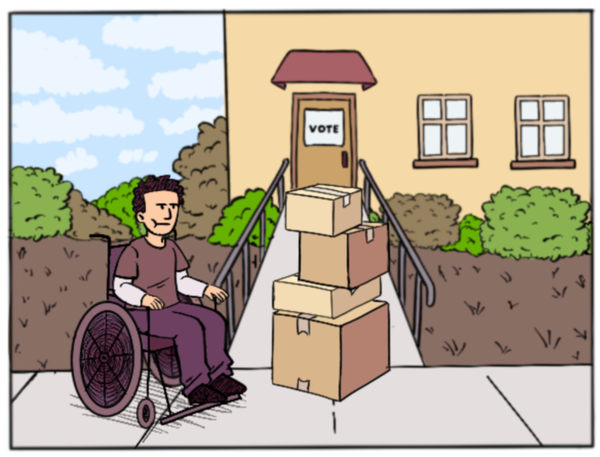
Imagine arriving at your polling place on Election Day, ready to vote, only to find boxes blocking the wheelchair ramp. The building has an accessible entrance, but you can't use it. You can't get inside to ask an election judge for help, either.
What happens next?
Under the Americans with Disabilities Act (ADA), election officials must provide voters with disabilities an equal opportunity to cast their ballots. That includes ensuring polling places have accessible routes, entrances, and voting areas.
Having a ramp isn't enough if voters can't use it.
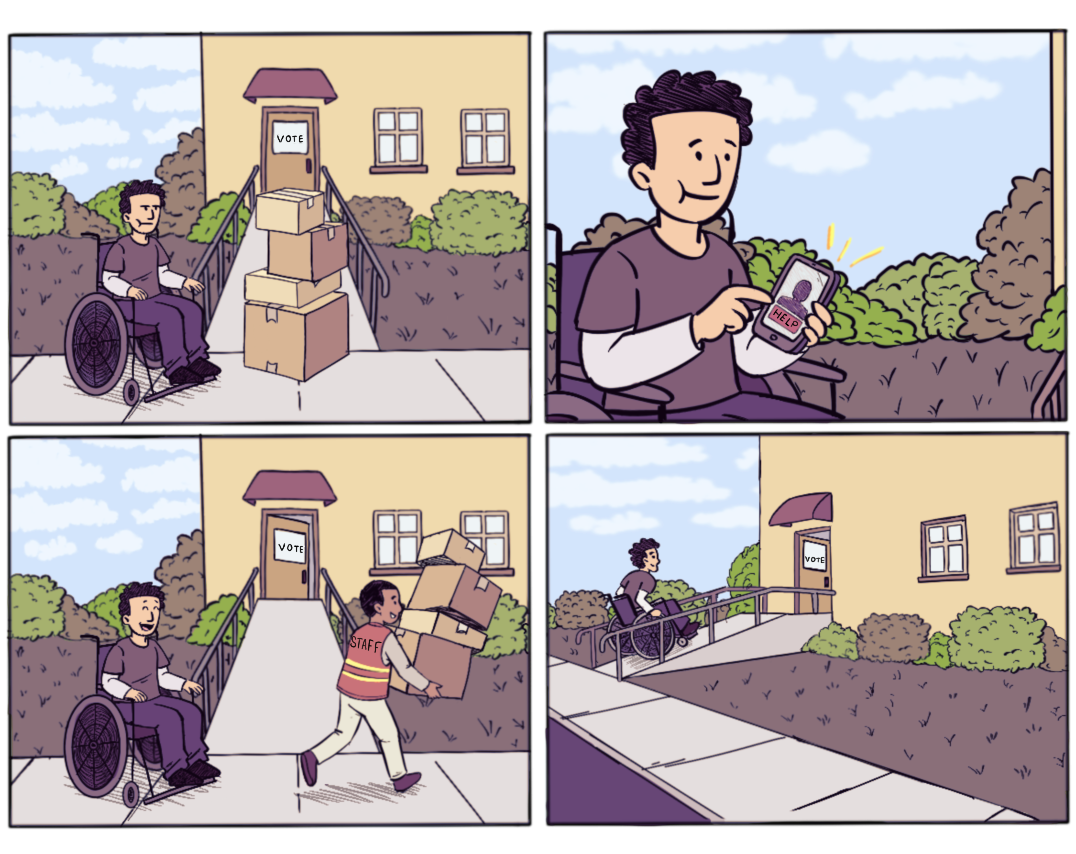
A voter discovers a blocked accessible entrance, uses their phone to contact the local election authority, and receives assistance from an election worker who clears the path. | Illustration by Sean Wall for 15 West. This is a fictional scenario.
Who's responsible for removing the barrier?
Election authorities are responsible for ensuring polling places are accessible, including those temporarily operating inside schools, libraries, and churches.
According to theU.S. Department of Justice, officials can use temporary measures such as portable ramps, doorstops, and alternative accessible entrances to address barriers.
But unexpected problems can still arise.
Tate Fall, a former elections director who has worked in disability voting rights, said election workers are expected to address temporary obstructions that arise on Election Day.
When a barrier can't be immediately removed, officials may be able to arrange another accessible way to vote at the same location.
For example, if an elevator stops working and the voting area is upstairs, election workers might arrange assistance on an accessible floor. If accessible parking becomes unusable, officials might consider curbside voting where state law permits it.
Fall said moving an entire polling place is generally a last resort because election authorities must also notify voters of location changes.
What should I do if I can't get inside?
1. Look for another accessible entrance.
Some polling places have separate accessible entrances. Look for signs directing voters to an accessible route. That entrance should remain unlocked during voting hours.
2. Ask an election worker for assistance.
If you can reach an election judge, explain what's preventing you from entering and ask for the barrier to be removed or another accessible arrangement.
3. Contact your local election authority.
If you cannot enter the polling place or reach an election worker, use your phone, if available, to contact the election office responsible for your location.
Explain where you are, describe what's blocking the entrance, and ask for assistance. Election officials may be able to direct you to another accessible entrance or arrange for an election worker to come outside.
Chicago Board of Elections: 312-269-7900
Cook County Clerk, suburban elections: 312-603-0906
If you don't have a phone, look for posted instructions or another way to alert election workers. When curbside voting is used as an accessibility accommodation, federal guidance says voters must have a way to request assistance that doesn't depend solely on calling ahead.
4. Report an unresolved problem.
If the barrier isn't addressed, you can also contact:
Election Protection: 866-687-8683 (call or text)
Illinois Attorney General Election Hotline: 866-536-3496
Equip for Equality: 800-537-2632
These organizations can provide assistance or receive reports, although contacting them does not guarantee the problem will be resolved immediately.
Can I vote outside the polling place instead?
Illinois has different procedures for voting outside a polling place, and the distinction matters.
UnderSection 17-13 of the Illinois Election Code, voters with temporary or permanent disabilities who cannot enter because of a building's structural features may request that two election judges bring a ballot outside.
That procedure requires submitting a request to the election authority by the close of business on the day before the election.
Illinois also permits election authorities to establish separate curbside voting programs underSection 17-13.5.
But what if the entrance becomes unexpectedly blocked on Election Day?
The advance-request procedure does not explicitly address every temporary obstruction.
Federal accessibility requirements still apply. The Justice Department says election officials must make necessary changes to voting policies and procedures to avoid disability discrimination, unless doing so would fundamentally alter the voting program.
However, federal guidance does not prescribe one automatic, same-day workaround for every inaccessible entrance. Fall said election officials would likely consult their legal counsel and Election Day staff to determine how to help the voter cast a ballot.
The appropriate response may depend on the barrier, the polling location, and applicable election procedures.
If you encounter a problem, contact your local election authority as soon as possible rather than assuming you can vote at another location or automatically receive a ballot outside.
Before you go
Illinois polling places will be open from 6 a.m. to 7 p.m. on Tuesday, November 3, 2026. Voters who are in line by 7 p.m. have the right to vote.
Find your assigned polling place and review available accessibility information before leaving home.
For more election information and accessible voting resources, visit15west.org/elections.
This reporting was made possible in part through support from Election SOS, a joint initiative of Indiegraf and Hearken.
How we reported this
15 West reviewed U.S. Department of Justice guidance on polling-place accessibility, Illinois Election Code Sections 17-13 and 17-13.5, and election administration resources.
We also consulted Tate Fall, a former election administrator with experience in disability voting rights, about how election officials respond to unexpected accessibility barriers. We connected with Fall through Votebeat's Election Expert Desk.
The accompanying illustrations depict a fictional scenario and do not represent a documented incident at a specific polling place.
You can republish this story unchanged for noncommercial use with attribution under our
CC BY-NC-ND 4.0 license.
For commercial use, translations, or additional permissions, see our republication guidelines.
NaBeela is a Greater Chicago-based photographer and journalist writing about what's possible. She's a fierce advocate of the arts and brings people together around social change and accessible education. Read more: nabeelawashington.com
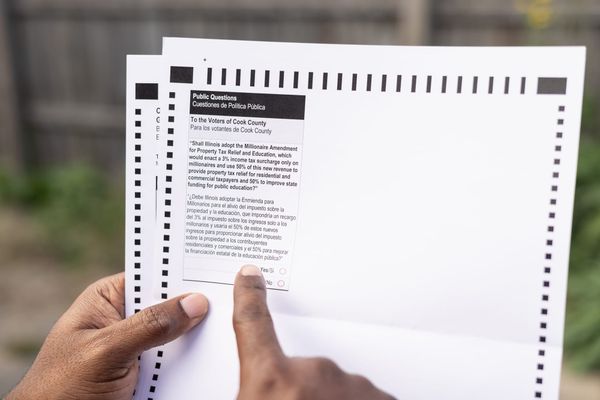
Un votante revisa la pregunta para el público del Condado de Cook que pregunta si es que Illinois debería imponer un suplemento de 3% a los ingresos que pasen $1 millón y dividir el dinero entre un relevo a los impuesto a la propiedad y a la educación pública. | NaBeela Washington/15 West