What’s at stake in Chicago’s school board president race?
Three candidates have different ideas about school closures, funding, and student resources. Here’s what the winner can influence and how families can make their voices heard.
Chicago's next school board president will face some difficult questions: How should the district address its financial problems? What should happen to schools with declining enrollment? And which programs should receive more resources?
Jessica Biggs, Hilario Dominguez, and Victor Henderson have different answers. But whoever wins on Nov. 3 won't make those decisions alone.
For the first time, Chicago voters will elect the president of the Chicago Board of Education, a position previously filled by mayoral appointment. The president will lead a 21-member board responsible for decisions affecting Chicago Public Schools.
From school closures to classroom funding, here's where the candidates stand, what the president can influence, and how residents can participate in decisions after Election Day.
Meet the candidates
Jessica Biggs is the only candidate currently serving on the school board, representing District 6B. A former CPS principal and teacher, Biggs has received support from former CPS CEO Janice Jackson and the Service Employees International Union. Her platform focuses on amplifying student voices, financial stability, and community collaboration.
Hilario Dominguez is a former Chicago Teachers Union deputy political director and former special education teacher. A graduate of Whitney Young Magnet High School, Dominguez has received the union's endorsement. His campaign prioritizes preventing school closures, expanding resources for neighborhood schools, and increasing public funding for education.
Victor Henderson is an attorney and Urban Prep Academies board member. CBS Chicago has described him as a former certified public accountant. Unlike his opponents, he has not worked as an educator. Henderson has received endorsements from former CPS CEO Paul Vallas and former candidate Jennifer Custer. His platform focuses on fiscal responsibility, partnering with families, and board accountability.
Two other candidates initially sought the position. Jennifer Custer withdrew on August 27, while Sendhil Revuluri suspended his campaign on September 30. Although Revuluri is no longer actively campaigning, his name will still appear on the November 3 ballot.
What power does the next president have?
The school board president leads board meetings, sets meeting agendas, and represents the board publicly. These responsibilities allow the president to influence which issues receive attention and move toward a board vote.
Beginning Jan. 15, 2027, the newly elected president will serve a four-year term and vote alongside the other 20 board members. Unlike the current president, whose vote is limited to breaking ties, the elected president will have the same voting power as other members, with no veto power.
The full board is responsible for districtwide policies, approving the CPS budget, and overseeing district leadership. The president also performs administrative duties, including signing contracts and leases the board has authorized.
Although the president holds a leadership position, the office does not come with the authority to independently approve budgets, close schools, or establish districtwide policies.
Three decisions the next board will face
The candidates offer different approaches to three challenges facing CPS. But turning those proposals into policy will require more than winning the presidency.
What happens to schools with declining enrollment?
Jessica Biggs
Biggs says CPS must listen to students and families when considering school closures. She points to her experience as principal of Burke Elementary, which was considered for closure in 2013 but remained open. “It is the district’s responsibility to listen to young people and families,” she said.
Hilario Dominguez
Dominguez supports extending the moratorium on school closures. He says that previous closures have not saved money or improved academics, but have contributed to increased community gun violence. “School closings don’t work,” he said. A 2026 study by researchers at the University of Chicago and Johns Hopkins found that shootings increased by approximately 10% near schools closed in 2013, compared with similar neighborhoods. The association was particularly concerning where school buildings remained vacant. “It’s about time we try something different.”
Victor Henderson
Henderson does not support extending the current school closure moratorium and says closing schools should be considered only as a last resort. He argues that declining enrollment makes it unrealistic to keep every school building open and that affected communities should help determine what happens to those spaces. He has suggested repurposing some buildings, including converting them into affordable housing. “It would be great to turn some of those buildings into affordable housing,” he said.
What the president can do
The president can influence how the board considers school closures but cannot close a school independently. Such decisions involve the full board and must comply with applicable state laws and district procedures.
A president's position on closures may shape discussions, but it does not determine the future of any particular campus.
Who decides how CPS spends its money?
Jessica Biggs
Biggs proposes a five-year financial recovery plan to improve CPS' credit rating. During a Chicago West Side Branch NAACP candidate forum, she also called for maintaining enough cash to cover at least two months of expenses. Biggs has urged the state to better fund services for students with disabilities and English learners. She opposed a budget amendment that assumed $150 million in state revenue the district had not secured.
Hilario Dominguez
Dominguez says CPS should pursue additional public funding rather than rely on spending reductions alone. He supports increasing education revenue through higher taxes on wealthy individuals and corporations and says he would work with state lawmakers to secure additional funding for CPS. He argues that those efforts should not place a greater burden on working families through property taxes.
Victor Henderson
Henderson proposes a forensic audit of CPS' roughly $10 billion budget within his first 90 days in office. In an August interview with the Chicago Crusader, he said the review would examine the district's financial records, contracts, revenue, and program results before recommending cuts. Henderson argues that CPS should demonstrate responsible use of existing funds before seeking additional state funding. However, the president could not authorize an audit independently. Under the board's bylaws, such a decision would require board approval.
What the president can do
The president can advocate for spending priorities and vote on the CPS budget, but the full board is responsible for approving it.
Some candidates' proposals also depend on officials outside CPS. Increasing state education funding or creating new state taxes would require action by state lawmakers.
Which resources reach students?
Jessica Biggs
Biggs prioritizes early literacy and numeracy, particularly in kindergarten through second grade. “What's happening in our K-2 classrooms, across the district?” she asked during a Chicago West Side Branch NAACP candidate forum. In a separate forum covered by Chalkbeat, Biggs also emphasized services that support students beyond academics, including food, arts, and health programs.
Hilario Dominguez
Dominguez wants to expand neighborhood schools' access to food programs, restorative justice support, sports, music, and arts education. At a Chicago West Side Branch NAACP candidate forum, he also called for scaling up existing internship and apprenticeship opportunities so high school students could earn academic credit and receive pay for their work. His broader vision includes connecting schools to community resources such as clinics, grocery stores, and affordable housing.
Victor Henderson
At a Chicago West Side Branch NAACP candidate forum, Henderson said CPS should direct more resources toward classroom instruction and support for teachers. “I would do everything I can to lengthen the school day and to lengthen instruction time,” he said. Henderson also supports recruiting more Black male teachers and principals and strengthening academic rigor.
What the president can do
The president can advocate for student programs and classroom investments, but funding and districtwide policy decisions require broader board action.
Whether those proposals reach individual classrooms also depends on CPS administrators, school leaders, available resources, and implementation.
What could these decisions mean for West Side schools?
The next president's priorities could affect decisions about school funding, enrollment, and the programs available to students across Chicago, including on the West Side.
Chalmers Elementary School in North Lawndale illustrates one approach to declining enrollment. In 2025, Chalkbeat and ProPublica reported that the school served approximately 210 students in a building designed for 600. Rather than closing the school, CPS invested in renovations and programming intended to expand science, technology, engineering, arts, and math (STEAM) education. Students returned to new engineering, computer, and arts spaces. The investment illustrates a choice school leaders and district officials face: whether to consolidate underenrolled schools or invest in programs that could attract and retain students.
While the president is elected citywide, residents also elect district representatives who vote on policies and budgets affecting schools throughout Chicago.
Candidate controversies and responses
The three candidates have faced questions about their professional or personal histories. These summaries draw on published investigations, court records reviewed by other newsrooms, and candidate responses. Updated October 29, 2026.
Jessica Biggs: CPS dismissal and attendance records
Jessica Biggs was fired as principal of Burke Elementary in 2018 following a CPS inspector general investigation. Investigators found that staff, at Biggs' direction, improperly recorded students as tardy instead of absent and violated student transportation policies. The inspector general recommended discipline but did not recommend firing her. Biggs maintains her dismissal was unjust and has acknowledged some policy violations. CPS removed her from its Do Not Hire list in August 2025, after previously rejecting her requests. A joint Chalkbeat and WBEZ investigation found unanswered questions about the reversal but no timeline evidence supporting allegations of a political exchange.
Hilario Dominguez: Misconduct allegations and investigation:
Hilario Dominguez faced allegations of inappropriate conduct toward a 17-year-old participant in a nonprofit summer program in 2017. Dominguez denied wrongdoing. CPS reopened an investigation in September 2026 after the woman came forward to speak with investigators. On October 14, the inspector general closed the case, finding insufficient evidence to substantiate sexual misconduct, according to WBEZ. A 34-page report released October 16 confirmed that conclusion but noted the alleged behavior, if established, would violate current CPS staff-student boundaries. The woman disputed the investigation's conclusions and requested an independent review. Sixteen Chicago alderpersons also called for an independent investigation into how the case was handled.
Victor Henderson: Allegations in family court records
Victor Henderson faced questions about allegations of physical abuse involving his sons that surfaced in 2011 divorce and custody proceedings. His former wife alleged that Henderson physically harmed their older son. A judge temporarily placed the children with their mother and prohibited both parents from using corporal punishment. Court records reviewed by WBEZ and Chalkbeat show Henderson later resumed unsupervised overnight parenting time. Henderson acknowledges disciplining his children but denies abusing them, emphasizing that no court established the allegations as fact. He has also said school employees should never use corporal punishment. Henderson argues that the allegations have been used against him for political purposes.
How can residents influence what happens next?
Electing a school board president is only one way Chicagoans can influence CPS. Residents can also follow board decisions, attend meetings, provide public comment, and contact their elected school board representatives.
Provide public comment. Residents who want to speak at a Chicago Board of Education meeting can register online or by calling (773) 553-1600. Registration generally opens 48 hours before a meeting and remains open for 24 hours. If more people register than there are available speaking slots, speakers may be selected through a lottery. Residents can also submit written comments. Review the board's public participation guidelines for instructions and deadlines. Speakers receive two minutes to address the board. If you're not selected to speak, you can still submit written comments using the form on the board's website or by mail.
Contact board members. Find the representative for your school board district and learn how to share concerns about district policies or student services.
Election Day is Tuesday, Nov. 3, with polls open across Chicago from 6 a.m. to 7 p.m. Early voting is already underway.
Although online voter registration has closed, eligible Chicago residents can still register and vote in person at authorized locations through Election Day.
Every eligible Chicago voter can vote for school board president, regardless of their school board district. For more information, check out 15 West’sChicago School Board Voting: An Accessible Guide.
How we gathered candidates' positions
This guide draws on candidates' published platforms, statements made during public forums, and reporting by other Chicago news organizations. Candidate quotations are attributed to their original sources, with links provided where available.
15 West is a community newsroom covering Chicago's West Side. This story was produced with support from Press Forward Chicago, an initiative of The Chicago Community Trust investing in local news and information.
Republish This Story
You can republish this story unchanged for noncommercial use with attribution under our
CC BY-NC-ND 4.0 license.
For commercial use, translations, or additional permissions, see our republication guidelines.
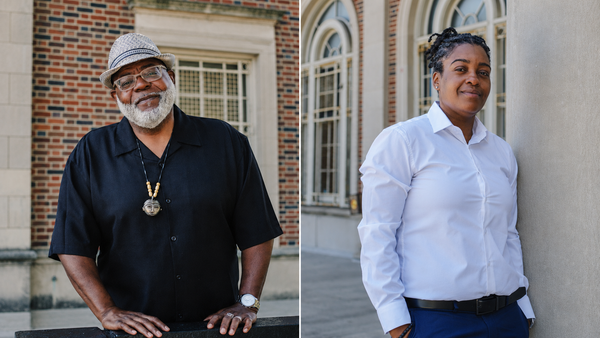
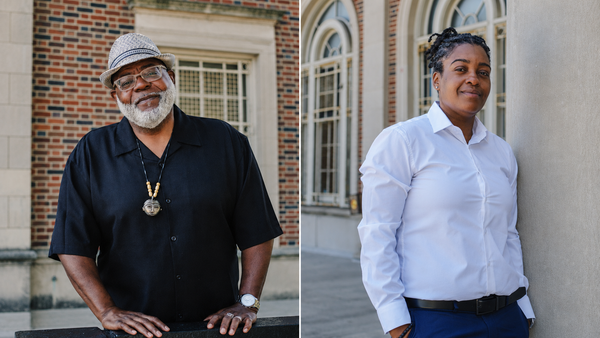
District 5B school board candidates Anthony Hargrove [LEFT], and Michilla “Kyla” Blaise participate in a Sept. 17 candidate forum hosted at Collins Academy STEAM High School. | NaBeela Washington/15 West
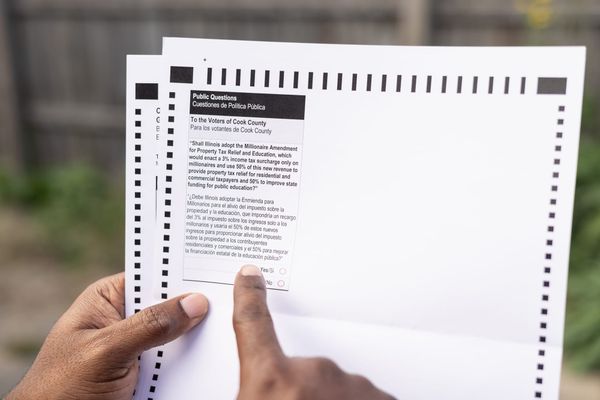
Un votante revisa la pregunta para el público del Condado de Cook que pregunta si es que Illinois debería imponer un suplemento de 3% a los ingresos que pasen $1 millón y dividir el dinero entre un relevo a los impuesto a la propiedad y a la educación pública. | NaBeela Washington/15 West