The biggest misconception about Local School Councils? They don't do anything.
Local School Councils remain the most direct way West Side residents can influence decisions at their neighborhood schools. But participation remains a challenge.
But for parents and community members looking to influence decisions at their neighborhood school, one of the most powerful opportunities happens every month.
LSCs play an especially important role in West Side neighborhoods where disparities in the size of Chicago's school board districts are most pronounced.
According to an analysis of CPS' 2025–26 20th-day enrollment data, District 5 includes 100 schools serving 35,593 students in neighborhoods like Austin, East Garfield Park, West Garfield Park and North Lawndale—more schools than any other district. By comparison, District 4, which includes several North and Northwest Side neighborhoods, has 34 schools serving about 23,000 students.
Because each school board district is represented by two subdistrict members, each District 5 board member represents roughly 50 schools, while each District 4 board member represents about 17.
That imbalance makes Local School Councils one of the most direct ways for West Side residents to influence decisions affecting their neighborhood schools.
Find your school board district using the interactive map below.
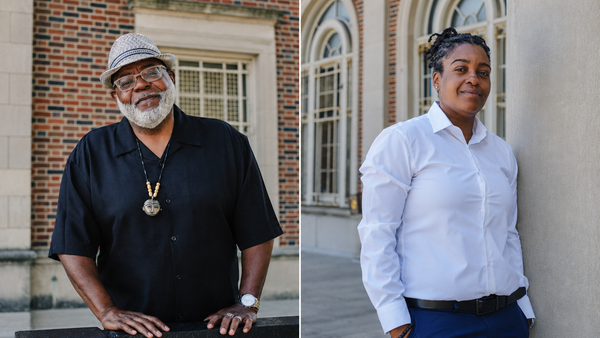
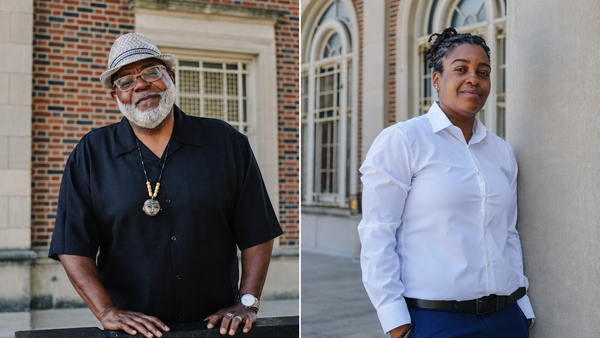
Bernard Clay, 75, has served as the community representative on Michele Clark High School’s LSC for about eight years. He believes engaged LSCs are especially important for West Side schools because they face "a lack of resources, a terrible lack of resources."
Clay said one of the biggest challenges is getting parents involved. He doesn’t believe the problem is a lack of interest. Instead, he said CPS has not made a concerted effort to recruit parents. “Parents are really the consumers of education," Clay said.
One obstacle, Clay said, is timing. Many LSC meetings are held during the workday or too early in the evening for working parents to attend.
He also argued that CPS "spends more resources on training the parents than actually recruiting the parents." While he considers training important, Clay said meetings and training should be offered during the evening or on weekends so more parents can attend.
Know Your Rights: What if an LSC meeting isn't open to the public?
According to Michele Clark High School LSC member Bernard Clay, residents who believe an LSC meeting was not properly noticed or was improperly closed to the public may be able to challenge the meeting under the Illinois Open Meetings Act.
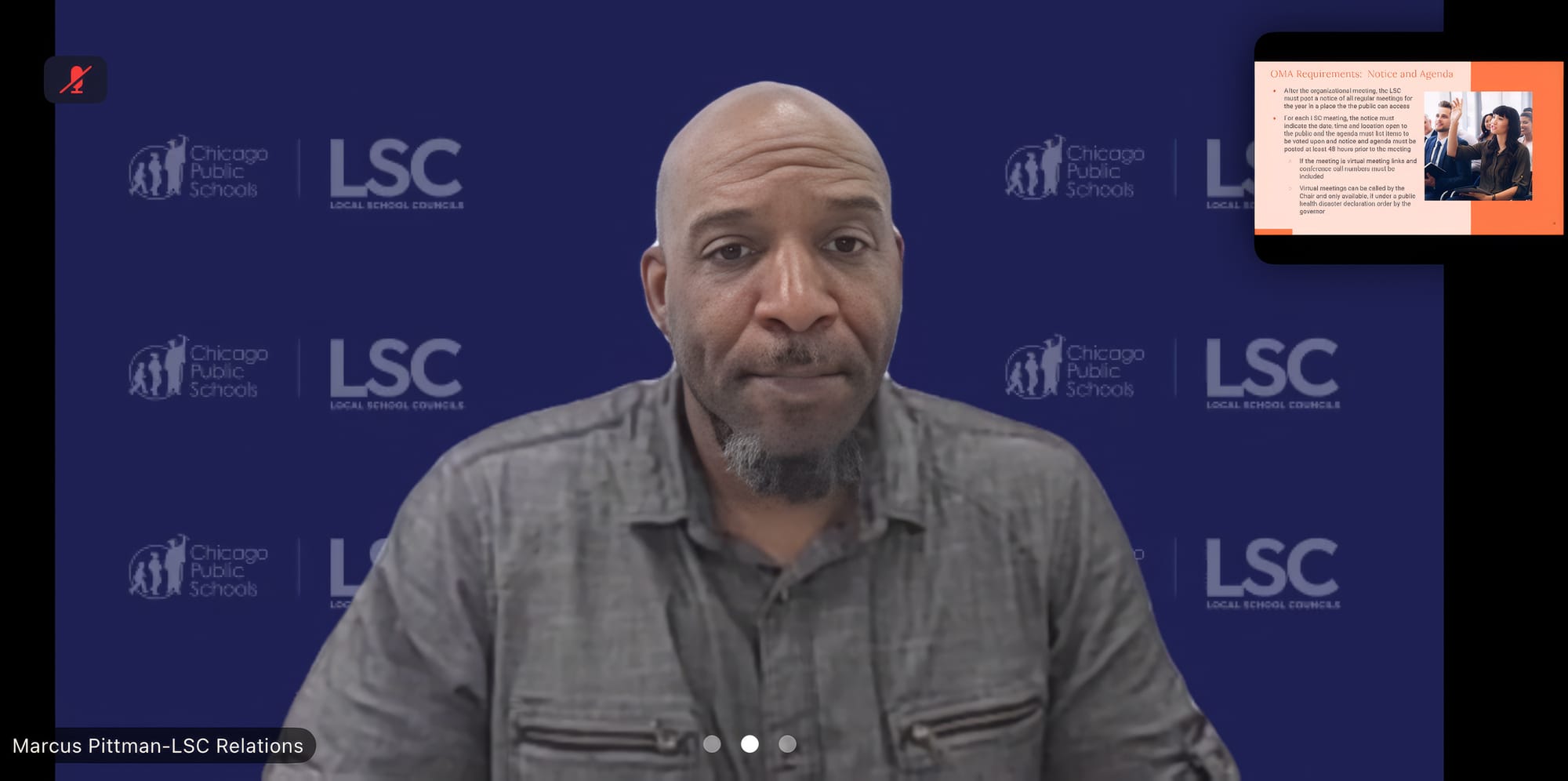
LSC Relations Specialist Marcus Pittman said councils are required to post meeting agendas in advance, and failure to follow public meeting requirements can result in meetings being canceled or rescheduled.
CPS officials acknowledge that making meetings accessible remains an ongoing challenge.
LSC Relations Specialist Marcus Pittman said councils are required to post meeting agendas in advance under the Illinois Open Meetings Act, and CPS occasionally receives complaints from residents who were unaware of meeting dates or agendas.
Pittman during July 14 Effective Meetings Course 2 for LSC members.
"We actually do sometimes get complaints about secret meetings being held, and not everybody knows about it," Pittman said.
During school visits, Pittman said one of the first things he checks is whether meeting agendas are posted where the public can easily see them. If agendas are not properly posted, councils may have to cancel or reschedule meetings. Posting the agenda, he said, "is the responsibility of the chairperson."
Even when meetings are properly noticed and open to the public, many LSCs still struggle to fill open seats.
District 5 alone has 36 schools with vacant parent and community representative LSC seats. Residents can use CPS' LSC Members Map to identify vacancies and learn how to get involved.
The next LSC elections will be held in the spring of 2028, but candidates can begin filing paperwork to run as early as October 2027.
Those interested in serving on their school's Local School Council do not necessarily have to wait until the next election. When a parent or community member seat opens up, eligible residents can fill the position if approved by a vote of the current LSC members.
Further, residents do not have to join an LSC to make their voices heard. Anyone can attend each school’s monthly meeting, where the floor is open for public comments. Bernard Clay believes residents should attend meetings and speak up during public comment because “it’s the best form of democracy.”
"The biggest misconception about LSCs is that they do not do anything," Clay said.
As Chicago prepares for its first fully elected school board, LSCs remain one of the most direct ways for community members to get involved with local education. And if more parents attended meetings, Clay said, “they would be empowered and feel that they could make a change.”
🍎 How to Get Involved with Your Local School Council
How are Local School Councils structured?
Each Local School Council is made up of parents, community representatives, teachers, school staff and students. Parent, community representative and student members are elected, while teachers and non-teacher staff are selected by their peers.
Most traditional LSCs include:
6 parent representatives
2 community representatives
2 teacher representatives
1 non-teacher staff representative
1 student representative (high schools only)
Find your school's LSC:
Use CPS’ LSC members map to see who serves on your school's council, find open seats, and learn how to get involved.
Attend a meeting:
LSC meetings are open to the public. Check your school's website or contact the school for the next meeting date, and review the agenda beforehand to learn what issues will be discussed.
Want to know what your LSC can actually do?
CPS publishes a Local School Council Reference Guide outlining council responsibilities, including budget approval, principal evaluation, school improvement planning, and public meeting requirements.
Interested in serving?
Parents and community members can run for open LSC seats as often as they meet the eligibility requirements. The next LSC elections are scheduled for spring 2028, with candidate filing expected to begin in October 2027.
Download our LSC zine!
Learn about Local School Councils with our 1-page zine!
15 West is a community newsroom covering Chicago's West Side. This story was produced with support from Press Forward Chicago, an initiative of The Chicago Community Trust investing in local news and information.
Republish This Story
This story is available for republication under a Creative Commons Attribution-NoDerivatives 4.0 International License. You may republish this article with attribution to the author and 15 West, but you cannot modify the text.
Nel is a editor and emerging journalist studying at DePaul University.
Comments
A voter reviews the Cook County public question asking whether Illinois should impose a 3% surcharge on income above $1 million and divide the revenue between property-tax relief and public education. | NaBeela Washington/15 West
A voter reviews the Cook County public question asking whether Illinois should impose a 3% surcharge on income above $1 million and divide the revenue between property-tax relief and public education. | NaBeela Washington/15 West